John Reed Miller Lectures

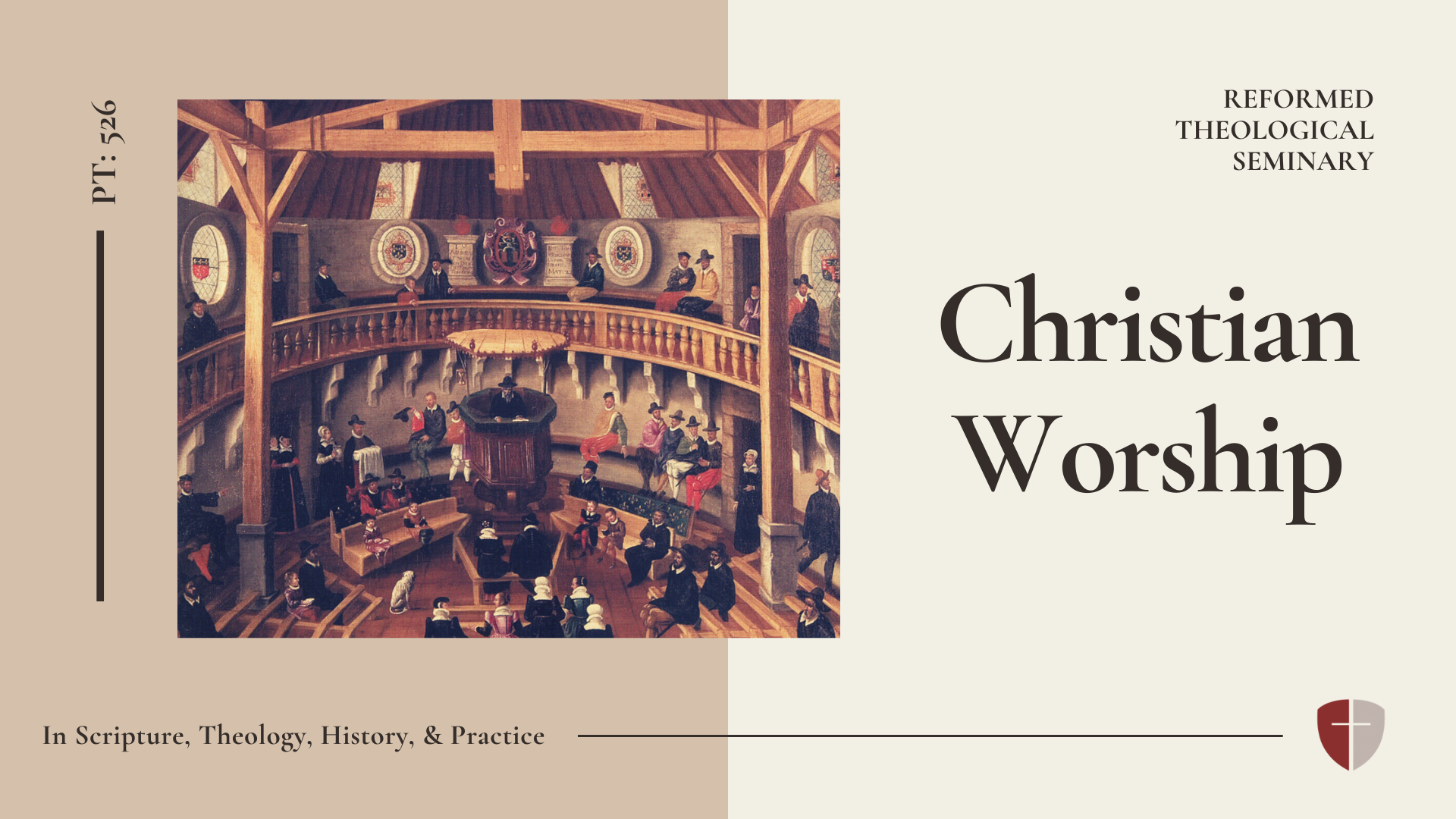
I was invited to give this year’s annual “John Reed Miller Lectures” on preaching at Reformed Theological Seminary, Jackson.

I came into my first pastoral call with no college education. I had no pastoral experience. Simply said, I had no clue what I was doing. But I had enough of a clue about my own inadequacy to know I needed mentors if I was ever to make good in the ministry. Being unmarried and thus unbound with my time, I read far and wide. I asked local ministers whom I deeply respected to meet with me regularly. In time, a company of carers surrounded me. Some were living, some had long passed to glory.   

I entered gospel ministry just a few weeks after turning twenty-one. I had just retired from a comet-like soccer career. It shone for a minute and then disappeared the next. I didn’t know it at the time, but I can see clearly now that my time playing football flickered away when it did because the Lord had decreed that the pulpit, not the pitch, be my calling.

Time has marched ever onward, and I’m now over two decades into pastoral ministry. I still often think to myself, “I don’t know what I’m doing.” But if twenty years have confirmed anything, it’s that I think I can recognize ever better those who do know what they’re doing or did know what they were doing. The Lord has used some of these to comfort and convict, others to strengthen and solidify, and yet more to encourage and exhort. But only two have saved my soul in ministry. One is living, Dr. Sinclair Ferguson, and the other is long gone, Robert Murray M’Cheyne.

So, when it came to the John Reed Miller lectures, I thought, “What do I have to offer? I’m not sure anyone is too interested in what Stone has to say.” But, I figured, there might be more utility in the talks if I centered them on someone who continues to interest so many people—Mr. M’Cheyne.

In the first three lectures, I tried to squeeze out the essentials of preaching as portrayed in M’Cheyne’s ministry. In the final lecture, I offered a series of proverbs on preaching, hoping to be as broadly practical as possible. You can listen to them here:

5 Points on Sermon Introductions

I recently came across the preaching books of J. Ellsworth Kalas. I wish I had known about his teaching earlier in my ministry; it would have saved me no small number of homiletical sins.

In 2003, Ellsworth published a handy little volume, Preaching from the Soul: Insistent Observations on the Sacred Art. The book is almost autobiographical as it unfolds Ellsworth’s conviction that “soul preaching happens when the speaker seeks to deliver not only a message, but his or her own soul, and to deliver it in a way that it reaches the soul of the hearer.” Good preaching inclinations will come from such a view. One such instinct relates to sermon introductions.

5 Points on Sermon Introductions

Ellsworth knows the old way of introducing sermons is not the best today. For most congregations, gone are the days when the preacher could rise to the pulpit and have his first sentence be, “Luke’s gospel tells us . . .”; or, “Today’s text in Colossians announces . . .”

A better way to think about introducing the sermon, Ellsworth says, is to think of it as a social interaction. In the introduction, we say something like, “Sermon and People, I really want you to know one another.” He writes,

We can’t always preach what people want to hear; indeed, we shouldn’t even try, lest we lose our prophetic credentials. But we do want the sermon to be heard, and that won’t happen (especially with unattractive themes) unless we entice interest at the outset. So my business, in the introduction, is first of all, to introduce two dear friends—the congregation I love, and the sermon I love.

Ellsworth then moves to provide five “qualities of a good sermon introduction.” No point is revolutionary. Rather, each one is clear, sane, and practical. I hear too many sermons in my line of work that can’t grasp the basics of an introduction, so here are the five points with some tiny commentary from the book.

  • A good sermon introduction should be intimately related to the subject of the sermon. “This is so obvious, so commonsense, that I would be embarrased to say it if it weren’t that so few introductions accomplish it. Quite simply, an introduction is no good unless it introduces.”
  • The introduction should consist of a single thought. “Listeners aren’t ready for complexity as the sermon begins; indeed, complexity is likely to discourage them from lisenting.”
  • The introduction should usually be brief. “If [the introduction] becomes an end in itself, it fails as an introduction.”
  • Prepare the introduction with special care. “No wasted words here, no fumbling about. The speaker may seem to be very casual, very low key, but never out of control. On the whole, I don’t favor memorizing a sermon, even though I plead strongly for preaching wihtout notes or manuscript. However, if any part of a sermon is justifiably memorized, it is the opening sentences.”
  • The introduction should arouse curiosity and interest. “Most worshipers come to the sermon willing to listen, but also with several competing thoughts on their minds. The preacher’s task is to make the sermon more interesting than those other matters, and than can be quite an assignment.”

What Gives Ministry Power

Reading church history always humbles the heart. You hear about the mighty ministers of old and the fantastic awakenings that rocked congregations and countries.

I’ve often thought, “What made the old ministers different? Why did they seem to possess such power in the Spirit?”

One Possible Answer

My typical answer to such questions has been to quote something from William Williams of Wern, a former giant of the Welsh pulpit:

The old ministers were not much better preachers than we are, and in many respects they were inferior, but there was an unction about their ministry, and success attended upon it now but seldom witnessed. And what was the cause of the difference? They prayed more than we do. If we would prevail and have power with men, we must first prevail and have power with God. It was on his knees that Jacob became a prince, and if we would become princes we must be oftener and more importunate upon our knees.

Williams said this in the early 1800s. I imagine many of us today think the nineteenth-century giants prayed more fervently than we do. Yet, Williams felt his offering little more than a tiny sparkle compared to a previous generation’s shining commitment to closet prayer. Are we any better today?

It’s typical for every generation to think the preceding one was more potent because they were more prayerful. Listen to what E. M. Bounds wrote in 1907,

The pulpit of this day is weak in praying. The pride of learning is against the dependent humility of prayer. Prayer is with the pulpit too often only official — a performance for the routine of service. Prayer is not to the modern pulpit the mighty force it was in Paul’s life or Paul’s ministry. Every preacher who does not make prayer a mighty factor in his own life and ministry is weak as a factor in God’s work and is powerless to project God’s cause in this world.

We should always consider the possibility that power in prayer is the missing component in many of our ministries.

Or Maybe This is The Answer

Another possible answer, and one I’ve routinely given, relates to personal holiness. In 2 Corinthians 5:14, Paul says the animating center of his ministry is “the love of Christ.” Such love is all-controlling and constraining. A ministry lacking in love for Christ is a ministry shriveled in its strength.

Maybe we’re not as powerful because we don’t love the Savior as we ought.

Someone said of Robert Murray M’Cheyne that “love to Christ was the great secret of all his devotion and consistency.” The analysis was insightful. Read through the various memorials of M’Cheyne’s ministry and you’ll observe a thread: his sincere holiness was singularly attractive. It was often his manner, more than his message, that cut hearts to the quick.

M’Cheyne believed that “it is not great talents God blesses so much as great likeness to Jesus. A holy minister is an awful weapon in the hand of God.”

God delights in using holy vessels in ministry (2 Tim. 2:21). Therefore, we should also reckon with the fact that our small pursuit of holiness prevents greater usefulness for Christ.

Another Answer I Also See

I recently was rereading some of Octavius Winslow’s lovely book, The Precious Things of God. He published the book in a decade of life that saw him bury one of his sons, two of his daughters, his mother, and his wife. I remembered that and thought, “Oh, there’s something there. Perhaps that’s more of the answer than I’ve thought.”

What came to mind was suffering. So many of the mighty giants of old suffered more than we do. They had an increased experience of what God told the apostle Paul, “My grace is sufficient for you, for my power is made perfect in weakness” (2 Cor. 12:9).

In the Lord’s upside-down kingdom, weakness is the way of power. Undoubtedly, many of them knew this at a level we don’t today.

I rejoice to live in a day when death’s threat is less constant and physical frailties are dealt with swiftly. That doesn’t mean, however, that the weakness that is so often a fruit of suffering cannot grow in the minister’s heart. It should. And it must.

We may struggle with prayer and piety compared to previous generations. And maybe, too, we haven’t learned the holiness and mightiness found in weakness.

A Few Points on Preaching Christ (Part 1)

Preaching Christ is the grand work of ministry. As with all great things, it can sometimes be difficult to describe. Nevertheless, there are at least three points worth discussing when thinking about what it means to preach Christ.

Preaching Christ is a hermeneutic.

Read through the apostolic writings, and you’ll discover their hermeneutical key: Jesus Christ. We must learn to read the Bible like Peter and Paul. Pastoral ministry is in a sad state if the apostles wouldn’t recognize the average pastor’s exegesis. Said differently, we’ve got it all wrong if the apostles couldn’t pass the normal hermeneutics course at a seminary. Dennis Johnson has rightly answered the concern of “whether it is legitimate to learn biblical hermeneutics and homiletics from the apostolic exemplars of the New Testament, because their interpretation by the Spirit of God gave them privileged access to revelatory resources not available to ordinary Christians and preachers.”[1]

The answer is, “Yes! The apostles are the master teachers.” The same Spirit working through them works through us to preach the same Christ.

We can—and should—preach Christ from every genre, theme, image, figure, and event in Scripture. Many helpful grids exist on seeing, and thus speaking, Christ from all of Scripture. For example:

  • Sinclair Ferguson offers four relations: 1) relate promise and fulfillment, 2) relate type and antitype, 3) relate the covenant and Christ, and 4) relate the proleptic participation in salvation and subsequent realization.
  • Sydney Greidanus uses seven ways: 1) the way of redemptive-historical progression, 2) the way of promise and fulfillment, 3) the way of typology, 4) the way of analogy, 5) the way of longitudinal themes, 6) the way of New Testament references, and 7) the way of contrast.
  • David Murray teaches ten ways to preach Christ: 1) in creation, 2) in Old Testament characters, 3) in God’s appearances, 4) in God’s law and commands, 5) in Israel’s history, 6) in the prophets, 7) in the types, 8) in the covenants, 9) in the proverbs, and 10) in the Biblical poets.
  • Gary Millar lists nine ways to get to Christ: 1) following out a theme through every stage to Jesus, 2) jumping immediately to fulfillment in Christ, 3) exposing a human problem and showing Jesus as the solution, 4) highlighting a divine attribute and showing Jesus as its ultimate embodiment, 5) focusing on the diving saving action in the text and salvation, 6) explaining a theological category and tying it to Christ, 7) pointing out sin’s consequences and finding the only remedy in Christ, 8) describing an aspect of human godliness and goodness and showing Christ as the epitome of it, or 9) seeing a human longing and pointing to Christ as its satisfaction.

Preaching Christ is an instinct.

Reject all formulas for preaching Christ. I’m sure we’ve all heard predictable “Christ-centered” sermons where the Savior pops up at the very end as the solution to a perceived problem in the text. We can, and must, do better.

In an article on “Preaching Christ from The Old Testament Scriptures,” Sinclair Ferguson writes,

Many (perhaps most) outstanding preachers of the Bible (and of Christ in all Scripture) are so instinctively. Ask them what their formula is and you will draw a blank expression. The principles they use have been developed unconsciously, through a combination of native ability, gift and experience as listeners and preachers. Some men might struggle to give a series of lectures on how they go about preaching. Why? Because what they have developed is an instinct; preaching biblically has become their native language. They are able to use the grammar of biblical theology, without reflecting on what part of speech they are using. That is why the best preachers are not necessarily the best instructors in homiletics, although they are, surely, the greatest inspirers of true preaching.[2]

Consider a few ordinary illustrations of this point, beginning with the greatest jazz musicians. They have honed their craft to such a degree that not only is improvisation natural, but such instinctual on-the-spot playing is also their greatest joy. They are experts in scales, patterns, and keys. Therefore, playing their instrument is little more than the overflow of lifelong preparation that has sharpened musical instinct.

Preaching Christ must be the same. We have learned the types and contours of redemptive history to such a degree that we can’t help but pour forth Christ from every sermon.

A second illustration is how reading the Bible is like watching a movie with a startling ending. When you watch the movie the second time, you can’t help but interpret everything in light of your new understanding of the end. Once we realize that all Scripture points to Christ, the Spirit constrains us to preach the Savior from every page. We are not to be like Mary in the garden near Jesus’ tomb. Jesus was in front of her, yet she didn’t notice because she didn’t expect Him to be present. We know the full story: He’s there. So we look for Him in the text.

Preaching Christ is an encounter.

“Him we proclaim,” Paul announces in Colossians 1:28. He doesn’t say, “We explain truths about Christ.” No: we preach Christ.

True preaching is a personal encounter with a personal Savior. The truth is a person (John 14:6). An especially instructive text on this point is Ephesians 2:17: “And he came and preached peace to you who were far off and peace to those who were near.” The “he” is Jesus Christ. We must ask, “When did Christ come and preach to the Ephesians?” Various interpretations exist. But the right view is that Christ came to Ephesus through apostolic preaching. Christ still comes through faithful preaching.

The Second Helvetic Confession knows that preaching God’s word is an encounter with the living Word. Chapter 1 has a section titled, “THE PREACHING OF THE WORD OF GOD IS THE WORD OF GOD.” The first sentence confesses, “Wherefore when this Word of God is now preached in the church by preachers lawfully called, we believe that the very Word of God is proclaimed, and received by the faithful.” The Genevan Confession of 1537 says something similar: “As we receive the true ministers of the Word of God as messengers and ambassadors of God, it is necessary to listen to them as to him himself.”

Encountering Christ through the faithful preaching of his word is not a mere experience of the Savior: it’s a confrontation. Hear Paul’s word on this from 2 Corinthians 2:15–17, “For we are the aroma of Christ to God among those who are being saved and among those who are perishing, to one a fragrance from death to death, to the other a fragrance from life to life. Who is sufficient for these things? For we are not, like so many, peddlers of God’s word, but as men of sincerity, as commissioned by God, in the sight of God we speak in Christ.” There is no such thing as a neutral encounter with Christ. You are for Him, or you are against Him. You are in the light or the dark. You are receiving Him or rejecting Him. There is no neutral ground with Christ. Mere sympathy towards Christ has never saved a person. Detachment from Christ has never delivered anyone from sin and Satan.

Stick around for “Part 2,” which thinks about four other points on preaching Christ.

[1] Johnson, Him We Proclaim, 2.

[2] Ferguson, Some Pastors and Teachers, 672.

An Observation about Sermon Length


I once heard Carl Trueman say something like, “Many a great thirty-minute sermon turned into a poor fifty-minute sermon.” You surely know what he means. Maybe the sermon had an illustration or two that proved overly detailed. Perhaps the preacher meandered down three or four rhetorical rabbit holes. On the other hand, he may have had just too large a text. Or he could have had far too many unneeded cross-references.

A Maxim to Remember

In one of my preaching lectures at RTS, Dallas, I give students a few “Proverbs for Preaching.” They all seek to encourage future preachers about how it normally goes behind the pulpit and in churches. The one proverb that seems to stick best, probably because I have to repeat it most often, goes like this: the congregation will forgive you for a lot if your sermon is short; they’ll forgive you for little if your sermon is long.

I’ve seen this truth played out so many times that it seems indisputable. When a message goes long (length, of course, is contextual), and you’ll find most church members can only think of one thing: the sermon’s girth. However, if the sermon is shorter, people will remark on various points of use. Even if the sermon is poor, they’ll conclude, “At least it was short!” It’s always better to leave the congregation wanting more than wishing they heard less.

Common Culprits

My earliest pastoral experience happened in a movement that believed hour-long sermons were proof of one’s ability. I watched and listened to countless sixty-minute-or-more messages. Rarely, if ever, did they keep the attention of ordinary Christians. Even if the pastor could preach that long, extraneous content invariably bloated the sermon. What are the common homiletical culprits that expand sermons? Three things come to mind.

  • Lengthy illustrations. To illustrate is virtuous, but to over-illustrate can be disastrous. I once had to review the sermons of a preacher who wrote a much-used homiletical textbook. I discovered that his typical sermon was 55% illustrative material, with the other 45% belonging to explanation and application. His pattern is not as unusual as you might expect. Any sermon like this is not a sermon that illustrates a passage but a text attached to illustrations. Such a sermon will always lack power, for the power is found in the Spirit working through the Word.
  • Cross-reference commentary. Some strands of homiletics encourage pastors to spread cross-references throughout the sermon to underscore various points of teaching. Sometimes that’s good, but it is rarely necessary. Sermons full of biblical texts that aren’t the actual text at hand create messages that are more systematic-theological in nature than biblical-theological. Use other Scripture to explain any hard-to-understand phrases in the pericope, for sure. But most of your sermon passages will be clear enough. Which leads to the third culprit . . .
  • Excessive explanation. Even in non-Christian contexts, the text’s meaning is often obvious. Pastors can easily spend many minutes explaining a passage whose meaning is clear. Scripture is perspicuous, after all.  The true work is often not explaining what the passage means as much as it’s exhorting why the hearer must respond to it. I’m not belittling explanation. I’m only encouraging a sanctified instinct in preaching. The best preachers, on any given point, never say too much nor say too little.

Excise these culprits, and you’ll find a fifty-five-minute sermon shrinking automatically to a thirty-five-minute one (thirty to thirty-five minutes is probably best for most congregations).

More, Not Less

After explaining this to a friend years ago, he replied, “But our churches need more of the truth, not less!” I agreed—and still do. I only believe “more truth” doesn’t necessarily require longer sermons. Our churches don’t need longer sermons, but more sermons. But that’s a topic for a different day.

For now, let us all employ those twin towers of rhetoric—precision and concision—in preaching Christ. Doing that just might generate shorter sermons.

Theology of Worship Course

I’m eagerly preparing for an intensive winter course at RTS-Dallas called “Theology of Worship.”

I hope you’ll consider taking it for credit or as an auditor. All lectures will happen from January 21–24.

I’ve separated the material into traditional disciplines: Biblical Theology of Worship (1/21), Systematic Theology of Worship (1/22), Historical Theology of Worship (1/23), and Practical Theology of Worship (1/24). Obviously, there’s only so much I can say each day on a particular point. I trust, however, that my intended focus will be edifying for all. As you might expect, I’m tilting the applications in the direction of the Westminster Confession of Faith, but I think it will be useful to students from all denominations.

Check out the syllabus below and register here!

Loader Loading...
EAD Logo Taking too long?

Reload Reload document
| Open Open in new tab

Download [169.10 KB]

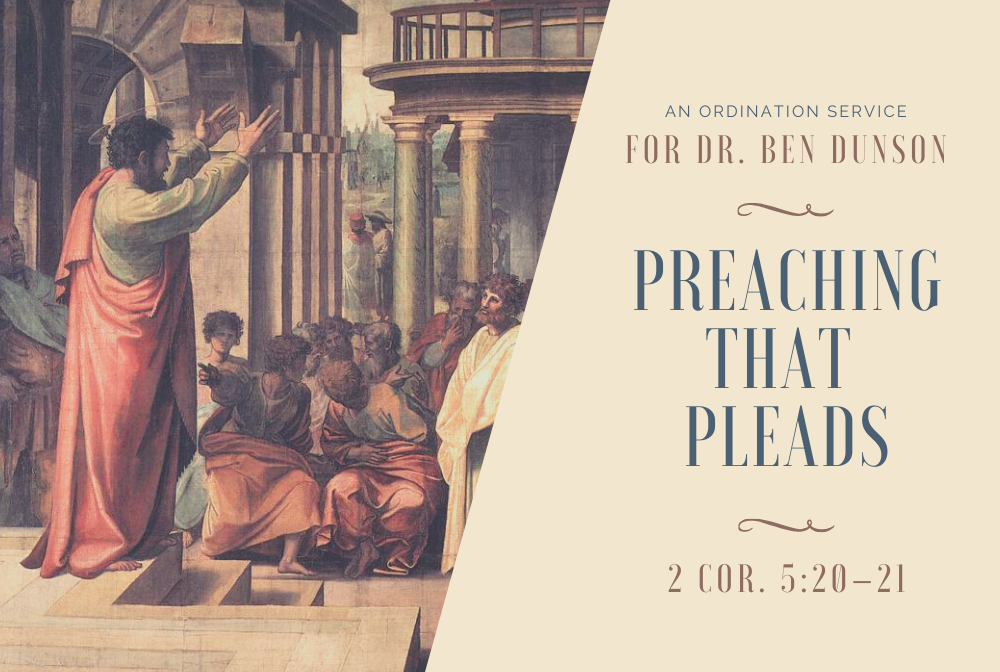
Preaching that Pleads

Earlier this week, while on a run with my children, we passed by a house that was clearly burning a friendly wood fire inside. The smell wafted out from the chimney and seasoned the trail before us. The scent immediately summoned memories of Christmases of years gone by spent at my grandparents’ home in Michigan. I have vivid memories of Grandpa Kuntzman regularly throwing a log on the fire, arranging it just right, and then poking and prodding the fire until it was fully aflame.

What our text tells us is that Christ’s church needs preachers who are lit with love for Christ (2 Cor. 5:14). We need heralds aflame with Christ and on fire to implore everyone, “Be reconciled to God.” Now, Dr. Dunson and Reformed Theological Seminary cannot put the fire in the homiletical fireplace—that’s the Spirit’s work. But they can, and must, throw logs on the fire, poking it and stoking it through their prayers, counsel, and instruction. They must do it because training men to preach the Gospel is one of the most essential jobs on earth.

On the chance that you don’t yet agree with that last statement, let’s pull together the two proofs in our passage.

Training men to preach the Gospel is one of the most important jobs on earth because of . . .

The place of God’s voice in preaching. When God’s preacher speaks, God speaks. When Christ is proclaimed through the preacher, none other than Christ is preaching. This is why Paul can say in Ephesians 2:17 that Christ, who never preached physically in Ephesus, nonetheless, “Came and preached peace to you who were far off and peace to those who were near.” If you’re a Christian, this means you must have a proper view of the preacher. Some of you need to decrease your view of the preacher; you’ve put him on too high a pedestal. He is not a messiah; he is God’s authorized messenger. He is not a savior; he is God’s ordained servant. But, some of you must have the humility of repentance and raise your esteem for preaching. Instead of responding to Christ in the preached word, you’re too busy ripping the pastor apart in your mind. If you understand our text correctly, that means you’re tearing the very word of Christ asunder. Such a truth should cause you to tremble.

The passion required of God’s servant in preaching. “I appeal,” and, “I implore,” Paul says. Such passionate pleading is only needed if the message is that important, and is that eternally significant. And it is.

Let us then have preachers who are on fire for Christ and preach accordingly. The story is told that when William Sangster was interviewing a candidate for the ministry, the nervous young man explained that he was quite shy and not the sort of person ever to set the River Thames on fire. “My dear young brother,” responded Sangster, “I’m not interested to know if you could set the Thames on fire. What I want to know is this: if I picked you up by the scruff of your neck and dropped you into the Thames, would it sizzle?”

Give us preachers, we cry, who are on fire for Christ and preach His word of reconciliation.

— This post is adapted from my recent sermon, “Preaching that Pleads,” on 2 Corinthians 5:20–21.

Ministry Adversaries

Having experienced many of the sorrows that Brian talks about in this sermon, I can’t commend his wisdom enough. Aspiring pastors would do well to note what he says about the initial two-year period.

Preaching with Unction (Part 2)

I once heard about a young preacher who had so much to say one Lord’s Day that he virtually ran up the pulpit stairs with anticipation. He made such a mess of the message that he walked down those same steps with his head bowed and tears in his eyes. He made his way slowly into the vestry. A wise old elder came to him and said, “If you’d gone up the way you came down, you’d have come down the way you’d gone up.”

Sometimes our expectation of power in preaching is our very undoing. Our presumption squelches the passion, and the congregation is no better after leaving.

Last time, we considered a definition of preaching with unction. In this post, I want to think about how we should pursue the Spirit’s blessing on our preaching. We must be sagacious at this point. While I believe the Bible gives us ordinary grounds for the Spirit’s blessing, it gives us no formulaic guarantee of spiritual power. The Spirit moves whenever and however on whomever He pleases. You will go wrong if you treat what I’m about to say as a guarantee.

What I am saying is that unless the following things are present, you have no reason to expect the Spirit to visit your preaching with peculiar power.

4 Things You Must Do If You’re to Preach with Power

You must preach Christ crucified. The Spirit loves to amplify Jesus Christ. He comes to glorify Christ’s name in all nations. When the sermon is in haste to preach Jesus Christ, you can expect that Spirit is eager to attend that service.

Let’s revisit The Upper Room. Jesus says in John 16:13–14, “When the Spirit of truth comes, he will guide you into all the truth, for he will not speak on his own authority, but whatever he hears he will speak, and he will declare to you the things that are to come. He will glorify me, for he will take what is mine and declare it to you.” J. I Packer spoke of the Spirit’s ministry as a spotlight ministry: he delights in putting Christ in the highest light. When preachers follow the apostolic agenda for preaching Christ, they continue a Spirit-approved plan for building the church.

You must preach in dependence. Phillips Brooks said, “Never allow yourself to feel equal to your work. If you ever find that spirit growing on you, be afraid.” The sin of self-sufficiency is to unction as baking soda is to a stove fire. No man can depend on himself and burn with the spirit.

This is the essence of what Paul’s after in 1 Corinthians 2 when he says, “My speech and my message were not in plausible words of wisdom, but in demonstration of the Spirit and of power.” Logical speech and lofty rhetoric were tools in the apostle’s bag of tricks, but he knew they had no place in the preaching of Christ. Such human ability robs Christ of His glory and signals the Spirit is not needed. Such a preacher may blow hard, but he’ll prove to be just that: a blowhard. Piper cries, “How utterly dependent we are on the Holy Spirit in the work of preaching! All genuine preaching is rooted in a feeling of desperation.”

Until you learn the lesson of total dependence on the Spirit, you’ll struggle for familiarity with the Spirit’s movement. If you are genuinely called to the ministry, you will learn the lesson of dependence one way or another. God tends to make his preacher’s through heartbreak and suffering. It’s only when selfish dreams are dashed, refashioned after Christ’s kingdom, and release by the Spirit that a man will truly preach. Elijah had his depression. Jeremiah had the pit. Peter had his denial. And Paul had his thorn. A march through church history uncovers profound sorrow behind and underneath those preachers that God has used.

You must keep in step with the Spirit. Paul told the Thessalonians to not quench the Spirit (1 Thess. 5:19). He exhorted the Ephesians, “Do not grieve the Holy Spirit of God, by which you were sealed for the day of redemption” (Eph. 4:30; see also Psa. 78:40; Isa. 63:10). Of course, unrepentant sin is a barrier to spirit-filled preaching. Sincere spirituality means the channel through which the Spirit flows is clean and unimpeded by the rot of impurity. For the Great Apostle, purity was a necessity in pastoral holiness—see 1 Tim. 1:5, 5:22; 2 Tim. 2:20–22.

Return with me to The Upper Room. Jesus says something about the primacy of holiness in ministry. It’s a truth that’s all too often neglect, and probably explains our weak efforts in preaching. In John 14:21, Jesus says, “Whoever has my commandments and keeps them, he it is who loves me. And he who loves me will be loved by my Father, and I will love him and manifest myself to him.” Christ delights to visit—manifest Himself—the obedient servants. Unction is not identical to ardent piety, but ardent piety is the air in which unction can live and thrive.

Brothers, let me give you a warning on this point. You cannot relax your watch against Satan’s schemes to get you to fall into sexual sin. No snare entraps more pastors than impurity. Paul warns against this in 1 Thessalonians 4:7–8, “God has not called us for impurity, but in holiness. Therefore whoever disregards this, disregards not man but God, who gives his Holy Spirit to you.” To disregard the need for purity is to say you don’t need the Spirit in preaching.

You must pray for the Spirit. Jesus said in Luke 11:13, “If you then, being evil know how to give good gifts to your children, how much more will your heavenly Father give the Holy Spirit to those who ask Him!” Too many preachers do not have because they do not ask. Our small prayers for the Spirit reveal our great trust in our own gifts. Too many preachers today spend hours in sermon preparation and only a few minutes in prayer. I understand the need for maintaining a spirit of prayer throughout the entire process of preparation. I don’t understand, however, why so many preachers think multiple, long periods of sustained prayer for the sermon aren’t necessary each week. Spurgeon said, “The best and holiest men have ever made prayer the most important part of pulpit preparation.” Or, in another place, “The fact is, the secret to all ministerial success lies in prevalence at the mercy seat.”

Brothers, the Worm named Satan will tempt you to fill your schedule with counseling, discipling, and sermon preparing, so that there is no time for prayer. Good things can sqaush the greatest thing.

A pastor who doesn’t pray is a pastor who doesn’t believe he needs the Spirit.

I’ll let the Prince have the final word this morning. Spurgeon said, “The gospel is preached in the ears of all; it only comes with power to some. The power that is in the gospel does not lie in the eloquence of the preacher; otherwise men would be converters of souls. Nor does it lie in the preacher’s learning; otherwise it would consist in the wisdom of men. We might preach till our tongues rotted, till we should exhaust our lungs and die, but never a soul would be converted unless there were a mysterious power going with it the Holy Ghost changing the will of man. Oh Sirs! We might as well preach to stone walls as preach to humanity unless the Holy Ghost be with the Word to give it power to convert the soul.”

Preaching With Unction (Part 1)

I remember hearing an interview with Carl Trueman about Martyn Lloyd-Jones’ book Preaching and Preachers.

In it, he said, “Half of the book is brilliant, and half of it is completely bonkers. . . . Lloyd-Jones has these sections where he talks about ‘unction.’ And these things have gripped a variety of people who have read this book. Lloyd-Jones talks about going into the pulpit on some days, and he’s flying. He’s got unction. Other days he goes into the pulpit and the unction just isn’t there. My experience has been that I can go into the pulpit and think that I am flying, and a lot of people think I’ve preached a complete clunker. . . . I’ve become aware that how I respond to the sermon is no guide for how the congregation responds. I have a feeling that Lloyd-Jones is confusing—dare I say it—‘carnal response’ to his sermons with the action of the Holy Spirit.”

I understand what Truman is saying. Preachers are not infallible interpreters of how their sermon goes. In my ministry, it’s common to think I preached an excellent sermon only to discover the majority found it ho-hum. It’s also frequent to believe my sermon was a disaster only to find out it helped an enormous swath of the congregation. Dr. Trueman is right on this point.

But we should not throw out the notion of unction altogether. It’s in the Scriptures. Church history testifies to its reality.

Defining the Indescribable

Part of the problem in discussion unction relates to how we define it. Its nature makes it almost ineffable. As Alexandre Vinet, the French preacher, said, “Unction is felt, and known by experience; it cannot be analyzed. It produces its impression secretly, and without the aid of reflection. It is communicated in simplicity, and received in the same manner by the heart, into which the warmth of the preacher passes. Ordinarily, it produces its effect without awakening our consciousness of its presence, and without our being able to render a reason to ourselves of the impression which it has produced upon us. We feel,—we experience,—we are moved,—we can hardly assign a reason, why.”

To say the experience of spiritual power in preaching is hard to describe is different than saying it’s impossible to describe. There are multiple places in Scripture where we discover what happens when the Spirit falls on a preacher.

5 Marks of Unction

As I read the Bible, there are at least five things that can be true when the Spirit arrives with unusual force in the preaching. Unction doesn’t mean all five happen at once. More often than not, it may be more like a momentary combination of a couple of these points.

Unction enflames the preacher. The Spirit falls on the apostles in Acts 2 and tongues of fire fly over them. On the road to Emmaus, Jesus’ teaching strangely warmed the hearts of the disciples (Luke 24:32). YHWH commissions Jeremiah and says, “Behold, I am making my words in your mouth a fire” (Jer. 5:14). No doubt, this enflaming passion came to mark Jeremiah’s ministry, as he said, “If I say, ‘I will not mention him, or speak any more in his name,’ there is in my heart as it were a burning fire shut up in my bones, and I am weary with holding it in, and I cannot” (Jer. 20:9).

Unction gives the preacher a sense of unworthiness. God’s spirit is the Spirit of holiness (Rom. 1:4). When the Spirit falls, there is inevitably a sense of one’s unworthiness. The preacher’s disposition is that of Isaiah, who cried, “Woe is me!” (Isa. 6:5). To preach about Christ’s salvation and man’s sin without any pathos, without any sense of an affected heart, is to preach the Good News without the Spirit.

Unction stamps the preacher with the seal of God’s authority. John Owen, in a sermon titled, “The Duty of a Pastor,” said authority is required of God’s preachers. He asks, “What is authority in a preaching ministry? It is a consequent of unction, and not of office. The scribes had an outward call to teach in the church; but they had no unction, no anointing, that could evidence they had the Holy Ghost in his gifts and graces. Christ had no outward call; but he had an unction.” Remember the times when Jesus’ preaching left the crows and religious leaders marveling, for he spoke “as one who had authority” (e.g., Matt. 7:28–29).

Unction provides unprepared-for clarity. Sermon preparation is often little more than working for clarity in exposition and application. But there are times in preaching when unexpected clarity comes. You say something better than you thought you would. An unanticipated logic flies from your lips. That’s the Spirit’s work! Jesus told his disciples that times would come when persecution would require extemporaneous preaching. He comforted them by saying, “When they bring you before the synagogues and the rulers and the authorities, do not be anxious about how you should defend yourself or what you should say, for the Holy Spirit will teach you in that very hour what you ought to say” (Luke 12:11–12).

Unction brings boldness related to the matters of eternity. Courage in preaching Christ might be the most common facet of unction. Trace out the theme of boldness in Acts 4 and see what this meant for the apostles’ ministry. In Acts 4:13, the religious leaders “saw the boldness of Peter and John, and perceived that they were uneducated, common men, they were astonished. And they recognized that they had been with Jesus.” In 4:29, the believers pray in the face of opposition, “Lord, look upon their threats and grant to your servants to continue to speak your word with all boldness.” The prayer is answered through the Spirit, as Acts 4:31 says, “And when they had prayed, the place in which they were gathered together was shaken, and they were all filled with the Holy Spirit and continued to speak the word of God with boldness.” Sinclair Ferguson says,

“The hallmark of the preaching which the Spirit effects is ‘boldness’. . . As in the Old Testament, when the Spirit fills the servant of God he ‘clothes himself’ with that person, and aspects of the Spirit’s authority are illustrated in the courageous declaration of the word of God. This boldness appears to involve exactly what it denotes: there is freedom of speech. We catch occasional glimpses of this in the Acts of the Apostles. What was said of the early New England preacher Thomas Hooker becomes a visible reality: when he preached, those who heard him felt that he could pick up a king and put him in his pocket!”

How Do We Get It

The five points above give shape to how we understand unction. But how do we pursue it? That’s what we’ll think about in Part 2.