
I love to read. By God’s grace I am a pretty fast reader; I usually read a couple books each week. I find it helpful to summarize my thoughts on each book and I offer those thoughts in the hope that you will be encouraged to either read or pass over the given title.
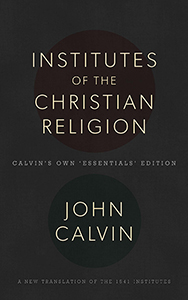 The Institutes of the Christian Religion by John Calvin. Banner of Truth continues, with quiet significance, to serve the church through republishing classic works of Puritan and Reformed theology. Their most recent offering of unusual importance is Robert White’s translation of the 1541 edition of Calvin’s Institutes of the Christian Religion. Carl Trueman says, “Calvin aficionados will know that the 1539 and 1541 editions embody key structural changes and elaboration of the somewhat brief 1536 edition and stand in significant continuity with the 1559. It is also worth knowing that the French editions were often less caustic about opponents and more explicitly precise in their polemical targets than the Latin.” This volume might be the best introduction into the great Reformer’s theology for the average lay member. It functions like an “abridgement for the common man” of the final, and most widely used, 1559 Latin edition. If you have some extra Christmas dollars lying around next month buy this book and slowly work through it next year. An immense spiritual feast awaits.
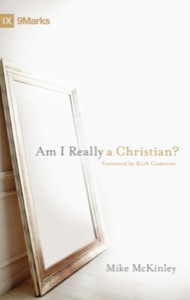 Am I Really a Christian? by Mike McKinley. It’s rare I hear anyone recommending this book, but recommend they should. Am I Really a Christian? is the most accessible contemporary book on assurance any Christian can read. I reread it recently in preparation for a three-hour sermon on 1 John I hope to give before a group of college students this week. Anyone familiar with McKinley knows he possesses witty wisdom to boot and one can see it in how he titles the first seven chapters:
- You Are Not a Christian Just Because You Say That You Are
- You Are Not a Christian Just Because You Like Jesus
- You Are Not a Christian If You Haven’t Been Born Again
- You Are Not a Christian If You Enjoy Sin
- You Are Not a Christian If You Do Not Endure to the End
- You Are Not a Christian If You Don’t Love Other People
- You Are Not a Christian If You Love Your Stuff
The eighth chapter ably answers the logical question generated by the first seven, “Can I Ever Really Know If I Am a Christian?” “Yes you can!” says McKinely. But it’s the final chapter that makes this offering unique. There McKinley details the necessity of a local church in the assurance of an individual Christians. Not only can conversations on assurance become overly objective or subjective, they often become ridiculously individualistic. Placing assurance of salvation in the context of a local church is just what the conversation and doctrine needs. With a thoroughly irenic tone saturating the Christ-centered content, this is a book I’d love to see used in every church.
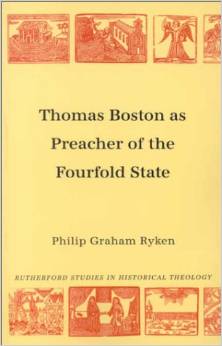 Thomas Boston as Preacher of the Fourfold State by Phil Ryken. Part of my master’s thesis was occupied with Boston and ever since then I’ve found myself returning to his works with increasing frequency. His life is fascinating and his ministry a model of faithfulness to the ordinary means. Jonathan Edwards was taken with the Scotsman, calling him a “truly great divine.” Edwards doesn’t seem to overreach; Boston’s most famous theological work, Human Nature in Its Fourfold State, was the widest selling English book in the 18th century. Thomas Boston as Preacher of the Fourfold State is a lightly edited version of Ryken’s doctoral dissertation and what a fine study it is. The prose is clear, the research immense, and the analysis incisive. Like any dissertation, the audience is limited. This title will be most attractive – and maybe even essential – for any student of 18th century evangelicalism.
 Power Through Prayer by E.M. Bounds. Whenever I need some counsel to quick start my devotion to prayer I usually turn to E.M. Bounds. The old Methodist man writes with a fervor and lucidity that constantly makes me drop his book to bend my knees before God. That’s what every book on prayer should aspire to do. Power Through Prayer is written to gospel preachers, so it will be of unique benefit to pastors. The chapters on “Men of Prayer Needed” and “Much Prayer the Price of Unction” will hit home for any man who regularly ascends to the sacred desk. Highly recommended!
 Humility by CJ Mahaney. I once heard Dever say Mahaney’s Humility should be the 28th book in the New Testament. Personally, that self-conscious exaggeration isn’t misplaced. I have a list of books I want to reread every year, and a list of books I must reread every year. There are only two books in that latter category and Humility is one of them. I bet it’s because I am so prone to pride and thus continually need the truth in this book. It always disrupts roots of arrogance and increases my affection for lowly weakness. If there is one book, outside of the Bible, I could get every church member to read and emulate, it would be this one. If you’ve yet to read it, order a copy today and let this Scripture-shaped scalpel do its work on your soul.
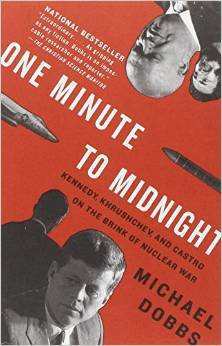 One Minute to Midnight: Kennedy, Krushchev, Castro on the Brink of Nuclear War by Michael Dobbs. My recent forays into historical fiction have included or focused on the Cuban Missile Crisis, so I figured it was time to read Dobbs’ highly commended treatment of that epochal event. Dobbs admits that the Crisis has generated a cottage industry of publications, theories, and analyses of those thirteen days in October. So why another book? His book is needed for two reasons. First, the discovery of new evidence that debunks popular myths that have surrounded the Crisis for decades. “Here, for the first time, are gripping accounts of Khrushchev’s plan to destroy the U.S. naval base at Guantánamo; the handling of Soviet nuclear warheads on Cuba; and the extraordinary story of a U-2 spy plane that got lost over Russia at the peak of the crisis.” Secondly, the book is utterly unlike anything in the field. Written like a thriller, Dobbs focuses on Black Saturday treating each hour of the day in one chapter. It feels almost like a 24 account of the Crisis. He should be applauded for not letting his exhaustive research slow down the fast-paced retelling. One Minute to Midnight is a mighty fine example of how thrilling history can be.
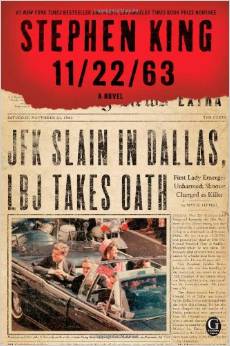 11/22/63 by Stephen King. For years I’ve had friends tell me King is one of the best American storytellers around. The problem is, for me at least, his stories are far too horrifying and gruesome to merit attention. One of those friends recently challenged my presuppositions saying, “You know all his stuff isn’t sci-fi horror right?” And so it was that I came across 11/22/63, a novel which takes as its title the date President Kennedy was assassinated. King’s novel focuses on Jake Epping, a high school English teacher from Maine, whose old friend Al Templeton shows him a time portal (“the rabbit hole”) in the back of a hamburger diner.
The rules are simple: walk through the rabbit hole and suddenly you’re back on Sept. 9, 1958. It’s 11:58 a.m. There are, Al says, only two conditions. One, it’s not a one-way trip. It doesn’t have to be. But when you return, no matter how long you’ve stayed in the past — two days, five years, whatever — only two minutes have gone by in the present. Two, each time you go back to the past, there is a reset. Like a Magic Slate. It’s 11:58 a.m., and everything you did on your previous trip has been erased.
Al is about to die of cancer and he reveals the time portal to Jake in hopes he will return and save Kennedy from Lee Harvey Oswald. The potential for good is enormous. “If you ever wanted to change the world,” Al tells Jake, “this is your chance. Save Kennedy, save his brother. Save Martin Luther King. Stop the race riots. Stop Vietnam, maybe. . . . You could save millions of lives.” And so, off goes Jake. The ensuing story is brilliant, engrossing, and moving.
This one was some kind of fun.
Click here to find other entries in the Recent Reads series.
Please note: I reserve the right to delete comments that are offensive or off-topic.