
The Supremacy of God in Preaching
(Grand Rapids: Baker, 1990), 25
The great design and intention of the office of a Christian preacher [is] to restore the throne and dominion of God to the souls of men. – Cotton Mather
The great design and intention of the office of a Christian preacher [is] to restore the throne and dominion of God to the souls of men. – Cotton Mather
Books are some of the best friends a pastor can have. How to know which friends to have is quite difficult, for as the inspired Preacher said, “Of making many books there is no end” (Ecclesiastes 12:12). Last week I suggested three books on pastoral ministry that every time-strapped and budget-strapped pastor should read. Here are my offerings for that most essential duty of ministry, preaching:
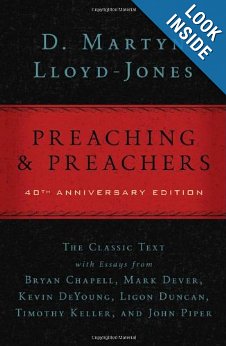 Preaching and Preachers by Martyn Lloyd-Jones. In 1969 Lloyd-Jones traveled across the pond to deliver a series of lectures on preaching at Westminster Theological Seminary in Philadelphia, which were published as Preaching and Preachers in 1972. “The Doctor” still has great relevance for preachers more than forty years later. Lloyd-Jones writes from the presupposition that preaching “is the primary task of the Church and the Christian minister.” It’s here that you find the timeless declaration that preaching is, “Logic on fire!” Also, the chief end of preaching “is to give men and women a sense of God and His presence.” You won’t agree with everything the good doctor thinks, but I promise he will make you think about preaching and preachers in a challenging way.
 Between Two Worlds: The Challenges of Preaching Today by John Stott. In this book Stott manages to cover an incredible swath of material. He covers the history of preaching, contemporary challenges to preaching, theological foundations for preaching, and practical considerations for preaching. In other words, there is something for everyone in this book! Of particular help are his chapters on preaching with “Sincerity and Earnestness” and “Courage and Humility.”
 Faithful Preaching: Declaring Scripture with Responsibility, Passion, and Authenticity by Tony Merida. This book sure seems to fly under the radar in discussion on preaching resources, but Merida is useful on so many levels. The book is broken down into four parts: 1) Trinitarian Convictions for Expository Preaching, 2) How Busy Pastors Prepare Christ-Exalting Expository Messages, 3) Watching Our Life and Doctrine, & 4) Preaching the Gospel in Our Generation. I enjoy how Merida interacts with relevant sources while remaining accessibly warm in presentation and wise in application. This book will encourage any seasoned preaching in his ministry and give any young preacher sound practices to employ.
The Supremacy of God in Preaching by John Piper. The only reason this book isn’t in the top three is it’s brevity; it comes in right around 100 pages. Buy it, read it, and preach the greatness of God.
Speaking God’s Words: A Practical Theology of Preaching by Peter Adam. Another lesser known book. You need a strong theology of preaching and this book offers you one.

“The saying is trustworthy: If anyone aspires to the office of overseer, he desires a noble task.” – 1 Timothy 3
Pastor, you are Christ’s gift to His church. Let this truth flood your soul with holy delight.
The holy delight of pastoral ministry is found in the apostle’s trustworthy saying to young Timothy, “If anyone aspires to the office of overseer, he desires a noble task.” Remind yourself often of the ministry’s nobility. It is a grand scheme of the Serpent to tempt you unto thoughts of boredom and purposelessness in your charge. Away with such evil! You are God’s steward and banality has no place in a ministry filled with nobility.
First, the message is noble. You have been entrusted with the gospel of Jesus Christ and a more noble message cannot be found on earth. Your eternal, creative, and powerful Father created this world to reflect His glory . He spoke everything into existence by the word of His power and He breathed life into man. Man was created in His image; he was to be a small icon of glory extending God’s lordship in the earth by ruling and subduing. But man wanted to rule as Lord, not just as vice-regent. He ate of the forbidden fruit and brought upon himself – and all his children – the promised curse of death. Yet, the curse was not without promise, for God promised woman that her seed would one day crush the head of the serpent.
This seed is none other than the God-man, Jesus Christ. In His love for sinners God sent His son to fulfill where man failed and slay the Serpent. Where man broke God’s law, Jesus obeyed. Where man succumbed to the serpent’s temptation, Jesus cast him out. After thirty-three years of perfection His people turned on him, because unrighteousness is never a friend to righteousness – let alone the Righteous One. He carried a log up a hill, laid Himself on it, and suffered the agony of crucifixion. Yet, while all His enemies gloated under the gleaming prospects of victory, the Serpent’s head was about to be smashed. In the greatest cosmic collision the world has ever seen God’s justice and mercy, simultaneously, fell on Jesus. He took our sin so that we might become righteous through Him, and He died because of it. God’s pleasure in His Son’s perfect sacrifice rolled the stone away and made Him alive in the tomb. He was raised for our justification, ascended to the right hand of God, and is now enthroned in glory. He cries out to the sons of Adam and call them to repent of their sins and place their faith in Him for salvation.
This is the message that you steward; the cosmic collision of a Serpent being smashed and sinners being saved. And a noble message demands a noble method.
Second, the method is noble. The apostle sums up your message with the command, “Preach the word.” Do not cower under the demands of the age to be a visionary leader, innovator, or movement maker. You are first and foremost a preacher. Your method is ascend each week to the sacred desk and herald the good news of Jesus Christ. Like the town criers of old you to look at the sheep and announce, “Hear ye, hear ye! This is the day of your salvation.” Your enemy has an arrow in his quiver marked for preachers and it flies on a path that goes something like this, “You think preaching is the method for this age? You are in trouble then, for no one will listen to you.” The Serpent is not a master of deception without good reason, because he’s right – no one will listen to you. But he forgets, and you are prone to forget, that the power of preaching does not rest in your cool rhetorical charisma. No, the power of preaching is found in the power of God’s word. His word is living, active, and able to bring the dead to life. His word is sweeter than honey, food for the soul, and more valuable than silver or gold.
Give yourself then to this work of preaching. Sweat yourself in preparation because treasure comes to those who search. Exhaust yourself in prayer because light comes for those who beg. Empty yourself in delivery because heat comes through those who plead. When you stand in front of Gods’ people you must shine and burn before them, just like that old voice who cried out in the desert, “Behold, the Lamb of God!” Should you do all of this in the Spirit’s power you will step down from the sermon with a weariness few can fathom. The Serpent knows your weakness and that’s why his arrows appear to blot out the sky after each sermon. If you are not watchful he will load your soul with crippling condemnation, “You failed. You didn’t get through. You were not engaging. You were not clear. Why did you ever think you could preach?” But oh! the Spirit knows your weakness as well. Look through the devil’s dark darts to truth that God’s power is made perfect in weakness. The Spirit is powerful to take your feeble offering and bring from it a bountiful harvest.
The message is noble, the method is noble, and . . .
Third, the mission is noble. Every steward is summoned to the front lines in His mission to redeem people from every tribe, language, people, and nation. The light of Christ has broken in and is shining to the ends of the earth. It shines on the dead and brings them life. It shines on the reborn and is making them new. Call your people to stare at the Son:
“Awake oh sleeper,rise from dead,
and Christ will shine on you.”
The mission shines then on the sands of the soul, and the soul is the noblest thing in a man. These sands represent the mission’s battleground and, like every battle, these sands are littered with the blood and bodies of God’s stewards. This mission is costly, for you it might even be deadly. But fear not! If you are slain on the sand a crown awaits and a glorified body is on its way. If the mission doesn’t kill you, it will probably cost you more than any person can see: scorn, slander, misunderstanding, and misrepresentation. For these reasons and more the Serpent will tempt you to stay in the ship and not wade your way toward the shore. Take courage! You have the armor of Christ and the power of the Spirit, what can mortal man do to you? The light you carry terrifies the darkness, so hide it not in your life nor your ministry.
The noble message carried by the noble method is the substance of your noble mission, a mission that aims at the noblest part of men. This is a noble ministry indeed.
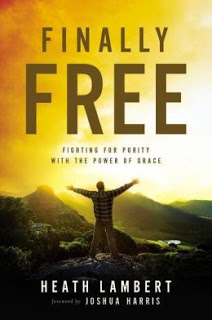 Carl Trueman has said, “Internet pornography is probably the number one pastoral problem in the world today.” Heath Lambert’s Finally Free: Fighting for Purity with the Power of Grace is a welcome contribution this most pressing problem. Lambert is the executive director of the National Association of Nouthetic Counselors and an associate professor of Biblical Counseling at The Southern Baptist Theological Seminary.
“This book is not about pornography. You can find countless book about pornography,” Lambert writes in the introduction (11). Some approach the issue by addressing the damage pornography does, still others spill much ink in showing people how to think about pornography. While not doubting the dignity of such approach, Lambert aim to fill a gap in the conversation, namely, “I want to share with you the amazing depth and effect Christ’s power to eradicate pornography from your life. Whether you struggle with pornography yourself or are trying to help someone who struggles, I have good news for you: no matter how intense or long-standing the struggle, it is the work of Jesus Christ to set people free from such sin” (12).
With his purpose articulated Lambert goes on in chapter 1 to explain the nature of grace. He encourages readers that, “It is possible to be free from pornography. Because of his grace, God sent his Son to pay the penalty for the sins we all commit. When you believe in God’s grace toward you, you get God’s righteousness” (19). And this righteousness is experiential. Lambert rightly remarks that the popularity of all things “gospel-centered” runs the risk of created people who delight in discussing the gospel’s power rather than experiencing the gospel’s power. “The danger in our day is taking grace for granted and not considering how to make it practical” (19). In order to make the fight for purity practical, the rest of Lambert’s book illuminates eight strategies in the fight.
The eight strategies are:
Lambert warmly weaves sound exegesis to case studies to practical exhortation with each strategy. His unfolding of godly sorrows true nature and fruit in chapter two is strikingly clear – in a good way. The chapter on accountability provides seven principles that “strengthen the common weakness we find in most accountability relationship” (47) and I found it to be the best wisdom on true accountability I’ve read. One choice nugget is when he writes, “You will not experience dramatic change in your struggle as long as you use accountability to describe your sins instead of declaring your need for help in the midst of temptation” (49).
One strength of Lambert’s work is that he is blunt when necessary, but the bluntness never contains unnecessary bite. It is always clearly tethered to Scripture and filled with a warmth that you would expect from such a seasoned counselor. For example, in the chapter on humility Lambert begins, “Here is the point I want you to get in this chapter: If you look at pornography, you are arrogant” (108, emphasis original). Using James 3:13-16 as his guide, Lambert so ably reveals the biblical reasoning for his pointed claim, that I think every reader will cry “Amen!”when he reads, “You can look at porn, or you can be humble. But you cannot do both” (109).
An added advantage of Lambert’s work is that each chapter concludes with with a list of next steps or questions for the reader’s consideration. Instead of being useless accessories these final meditation give pastors, small groups leaders, accountability partners, and struggling individuals direct counsel of where to go in light of each chapter’s truth.
One concern I have with the book is housed in the final strategy of “Using a Dynamic Relationship with Jesus to Fight Pornography” (135-148). Using John 6 as his guide, Lambert says, “Your relationship with Jesus is bigger than your struggle with porn” (142). His desire is to move the reader from being a consumer of porn to a consumer of Christ; “You need to be the kind of person who fights for a close relationship with Jesus more than you fight against pornography.” Amen! The three main ways we do this, he writes, is by reading God’s word, praying God’s word, and singing God’s word. Again, amen! But here’s my concern: Lambert never clearly ties these practices to the church. They are individual disciplines that a porn fighter should strive after to be sure, yet it would have been better for Lambert to show how these practices are enriched by and encouraged through the local church. I also believe that Lambert would have been wise to discuss how the Lord’s Supper – what we might call “seeing God’s word” – can fuel the fight for purity. The connection seems especially right in light of Lambert’s using John 6 to drive the chapter.
This concern need not be overblown. Lambert’s book is a fantastic grace-fueled filling of the gap in modern literature on the subject. If you took out the chapter on “Using Your Spouse (or Your Singleness)” to Fight Pornography” the book is actually a field manual for killing all kinds of sin. Surely one can use sorrow, humility, gratitude, and confession to slay various, fleshly enemies. I kept thinking that his strategies find a happy partner in the directives Owen provides in The Mortification of Sin.
I agree that “internet pornography is probably the number one pastoral problem in the world today.” Any Christian – pastor, small group leader, lay member – should read this book.
 The King in His Beauty: A Biblical Theology of the Old and New Testaments by Tom Schreiner. Schreiner is one of my favorite living biblical scholars. My appreciation is not rooted in the fact that I almost always agree with his conclusions (his understanding of the millenium withstanding), but in the fact that his scholarship is marked by such devotional warmth. He argues, along the lines of Graeme Goldsworthy, for the kingdom of God being “a central theme of the entire Bible” (xiii). There is pronounced emphasis on God’s lordship in the work and I deeply appreciated his focus on how human beings, created in the image of God, are supposed to relate to their Lord and King with praise, obedience, and fear. His handling of the Old Testament narrative is stimulating. Those familiar with his New Testament Theology and Pauline Theology won’t find much new in this book’s correlative sections, but that need not be seen as a weakness. The summary conclusions and interludes woven throughout the book make it all the more useful as a discipleship and teaching resource.
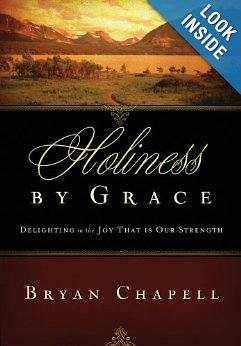 Holiness by Grace: Delighting in the Joy that is Our Strength by Bryan Chapell. Chapell’s aim is to help his readers delight in grace and employ “it to avoid the dangers of both legalism and licentiousness” (13). The work is something of a precursor (by about ten years) to the sanctification debates that peaked in “gospel-centered” circles a few years ago. While Chapell largely succeeds in his attempt to navigate between sanctification’s Scylla and Charybdis, “Holiness by Grace” is largely occupied with steering Christians away from the danger of legalism. I found the book to be longer than necessary, weighing in at 243 pages. One might say the length is due to the careful navigation required to get through the dangerous waters of law and licence, but I think it’s actually caused by undue repetition and over illustration. His chapters “Constrained by the Law of Freedom” and “What’s Discipline Got to Do with It?” are useful contributions to the contemporary conversation. Additionally, his discussion on the changing and unchanging dynamics between God and His children (196) is most helpful.
 The Pastor as Scholar & The Scholar as Pastor: Reflections on Life and Ministry by John Piper & D.A. Carson. This “book” consists, primarily, in two addresses given by the authors at a 2010 event under the same title. The book’s strength lies in a unified call for deep and clear thinking about God, but not letting such thinking be divorced from personal faithfulness or congregational edification. Carson’s discussion on reading habits is useful for any pastor or scholar. He writes, “If you can develop the habit of reading different things at different speeds, you might be wise to read some books slowly, evaluatively, and often; to read some books briskly, once but comprehensively; to skim other books to see what they are saying; to dip into still other books to see if they add anything to a discussion or merely say the same old things with a minor twist here and there” (97). Overall, this work on loving God with all your mind is worth rumination.
 The Secret Thoughts of an Unlikely Convert: An English Professor’s Journey into the Christ Faith by Rosaria Champagne Butterfield. Butterfield’s story of conversion is fascinating and fascinatingly written (no surprise here, see the subtitle). I came to the book expecting an engaging narrative of one surprising conversion, but what I didn’t expect were pots of gold along the way. Take these two quotes: “Sin, when unrestrained, infantilizes a person” (108) and “There is no greater enemy to life-breathing faith than insisting on cultural sameness” (115). Throughout the book I was continually struck by God’s powerful use of ordinary pastors to bring “unlikely” converts to faith. This is a book from which anyone can profit.
 Housewife Theologian: How the Gospel Interrupts the Ordinary by Aimee Byrd. I read this book in order to see if I wanted to buy a couple copies for the IDC Bookshelf at our church. Byrd’s phrase of “Housewife Theologian” is an excellent designation and, I trust, a biblical one. On the whole, Byrd’s book would be useful for any woman to read although I think it would be strengthened by a more discernible flow of argument. The journaling questions at the end of each chapter make this book a great resource for discussion and discipleship. Click here to listen to an excellent Christ the Center interview on this book.

And rising very early in the morning, while it was still dark, he departed and went out to a desolate place, and there he prayed. And Simon and those who were with him searched for him, and they found him and said to him, “Everyone is looking for you.”And he said to them, “Let us go on to the next towns, that I may preach there also, for that is why I came out.” – Mark 1:35-38
In 2010 The Museum of Modern Art hosted artist Marina Abramovic’s performance entitled “The Artist is Present.” For 736 hours she sat immobile in the museum’s atrium while spectators were invited to sit across the table from her. It really was little more than an artistic staring context. Yet, photographers were present to capture the spectators response(s) while sitting underneath the Serbian’s stare. Many responded with laughter and excitement, while others saw sadness and were thus pictured with tears streaming onto the table. Abramovic’s performance highlighted a fact of life that many know, staring evokes a response.
Mark 1:35-38 is a scene pastors need to stare at and I believe the staring will produce a response. Three insights from the text are of particular value:
First, see the priority of prayer. The start of His ministry had been a resounding success; His authority captivated the crowds in Capernaum. They clamored for His presence and power, and what is His immediate response? He withdrew to a desolate place in order to pray. Let’s briefly consider Jesus’ practice of prayer as presented in the gospels. When He was baptized we are told he was praying (Luke 3:21). When he was transfigured, we are told that His face was transformed as he prayed (Luke 9:29). Before He appointed the twelve disciples, Luke tells us He tells us He continued all night in prayer (Luke 6:12). After feeding the five thousand all the people want to crown Him as king, but He leaves them in order to pray (Mark 9:23). In the moments leading up to His betrayal, arrest, and eventually crucifixion we find Him crying out in prayer (Mark 14:32-42). Prayer was clearly a priority that fueled His mission.
Pastors would be wise here to be challenged by the Savior’s devoted to prayer. In commenting on this passage the great Bishop Ryle said, “Here is the pulse of our Christianity, here is the true test of our state before God.” 1 Pastor, how is the pulse of your ministry? I’d encourage you to consider what your practice of prayer reveals about your soul. The prayers of Christ are expressions of his dependence on God for strength, wisdom, and assurance. If prayer reveals dependence, what then does prayerlessness reveal? In a word, independence. Might our small progress in prayer be the rooted in a heart that finds greater joy in independence from God than dependence on God? Without prayer, pastoral ministry has no power. Charles Bridges famously quipped, “Prayer is one half of our ministry; and it gives to the other half all its power and success.” 2
Second, see the pitfall of preoccupation. The disciples cried out, “Where have you been, Jesus? You do not have time to seclude Yourself in prayer. You have ministry to perform. Your fame is spreading everywhere, and the place is filled with seekers. You need to be there not here.” We observe here, and find similar occasions all over the gospels, that a recurring pitfall for Jesus’ mission on earth was preoccupation with earthly concerns. The people’s – and disciples’ – concern was with health and happiness, not with the King’s demand for repentance and faith. The disciples’ preoccupation with secondary issues not only interrupted Jesus’ communion with God, but also threatened His mission for God. Pastor, what earthly preoccupations might be interrupting your communion with God and threatening your mission for God? We see in Mark 1 that no one makes progress in communion with God or mission for God who is not schooled in self-denial. There were compelling reasons for Jesus to stay and minister in Capernaum, but more compelling was leaving to fulfill the mission for which He was sent.
Third, see the primacy of preaching. This was Christ’s mission, to preach the gospel of the kingdom (Mark 1:38). The people wanted His healing and casting out of demons, but our Lord says He has come to preach.
We see that the spirit of the 1st century is just like the spirit of the 21st century. It’s a spirit that says, “This isn’t the time for preaching, this is the time for power. Signs and wonders will make people believe, but preaching will not.” Yet Jesus is telling us that in His kingdom, preaching is the highway to faith. We live by faith, not by sight. A kingdom built on signs and wonders is a kingdom built on sight, but a kingdom built on the Word is a kingdom built by faith. Preaching was the God-ordained means to extend the kingdom of grace, and preaching remains the God-ordained means to extend the kingdom of grace.
Pastor, God gave you to His church so that you would feed them with His word. This is the sum and substance of your work. Preaching builds, comforts, challenges, motivates, and sends the church.
A new week begins today. Let me encourage you to see the priority of prayer, the pitfall of preoccupation, and the primacy of preaching.
 Let me add this to them who are preachers of the word, or intend, through the good hand of God, that employment: It is their duty to plead with men about their sins . . .
A skillful master of the assemblies lays his axe at the root, drives still at the heart . . .
. . . Can sin be killed without an interest in the death of Christ, or mortified without the Spirit? . . . If such directions should prevail to change men’s lives, as seldom they do, yet they never reach to the change of their hearts or conditions. They may make men self-justiciaries or hypocrites, not Christians.
Books are some of the best friends a pastor can have. How to know which friends to have is quite difficult, for as the inspired Preacher said, “Of making many books there is no end” (Ecclesiastes 12:12). In an effort to serve time-strapped and budget-strapped brothers in ministry I am starting a, somewhat weekly, series called, “3 Books Every Pastor Should Read.” Here are my offerings for pastoral ministry:
 The Christian Ministry by Charles Bridges. For me, this is the best book ever written on pastoral ministry. Bridges’ dates (1794-1869) are too late to label him a Puritan in the historically defined sense of the term, but he is cut from the Puritan cloth in his view of pastoral ministry. The breadth of his work is astonishing as he leaves few stones unturned in relation the pastor and his ministry. Of particular help are his sections on “General Causes of the Want of Success in the Christian Ministry” and “Causes of Ministerial Inefficiency Connected with our Personal Character.” His wisdom on applying Scripture to various cases in pastoral ministry is timeless.
 Lectures to My Students by Charles Spurgeon. Every Friday afternoon Spurgeon would address the students of his Pastors’ College and this book collects the cream of the crop. In it you’ll find the Prince of Preachers riffing on everything from watchfulness to prayer to preaching to gesturing in sermons. Spurgeon had the rare balance of gravity and levity, and Lectures will challenge any pastor to greater reverence and joy in his ministry.
 The Shepherd Leader by Tim Witmer. When P&R published this book in 2010 I doubt the power at be could have known how well it would sell. It was Westminster Bookstore’s top-seller for 2010 (selling 6,000 copies in the first two days of availability) and ended up being P&R’s second most popular book of that year. This tells me that Witmer’s work filled a gap lacking in modern conversations on shepherding. The book is helpfully broken down into three parts, giving valuable teaching the principals and practices of biblical shepherding. His four-part matrix of shepherds “knowing, feeding, leading, and protecting” the sheep is the stuff on which faithful shepherding can grow.
The Cross and Christian Ministry by DA Carson. Kevin DeYoung said this book is destined to become a classic, and I couldn’t agree more.
Brothers We are Not Professionals by John Piper. This is Piper doing what he does best, biblical meditation that causes the soul to search.
 One of my favorite Puritans is named Thomas Boston. Among his most notable works are Human Nature in It’s Fourfold State, The Crook in the Lot, and The Art of Man-Fishing. The latter work was completed when Boston was the age of twenty-two and “has been constantly hailed by evangelicals as a masterpiece on ministry, worthy to stand on the same shelf as Baxter’s Reformed Pastor.” 1 Man-Fishing is a “soliloquy,” or sermonic meditation, on gospel ministry modeled after the word. It houses Boston’s personal thoughts on pastoring with faithfulness, evangelistic purpose, prayerfulness, single-mindedness, and enterprise in usefulness.
It just so happened that I read Man-Fishing earlier this year while preaching through 1 Timothy and I doubt a more pastorally challenging couplet for young pastors can be found. One text is inspired and the other is inspiring; it was a blessed elixir for this young pastor.
I ended up writing my own kind of soliloquy on pastoral ministry this summer in response and thought it could be useful to share with other young pastors and church planters. Thus, starting next week I hope to have a weekly “Pastoral Postcard,” 2 one short sermonic meditation intended to encourage pastors in long-term faithfulness and fruitfulness.
 Worship Matters: Leading Others to Encounter the Greatness of God by Bob Kauflin. Every Thursday I meet with a couple guys from IDC who lead us in song each week. It is our normal practice to review the upcoming service and discuss a book related to worship/music. We just wrapped up Kauflin’s book and the work is engaging and wide-ranging. He leaves precious few stones unturned in his aim to help worship leaders “think carefully about what we do and why we do it” (19). A valuable, and dare I say necessary, read for every pastor and worship leader.
 The Pastor’s Justification: Applying the Work of Christ in Your Life and Ministry by Jared Wilson. I hadn’t planned on reading this book until I saw Joe Thorn call it “an instant classic.” Although it didn’t join my personal list of classics, it is nevertheless a quick and encouraging read. Wilson is a gifted writer who understands the need for pastors to continually feed from the never ending well of Christ’s grace. I found his chapters on “The Holy Pastor” and “The Watchful Pastor” to be particularly encouraging.
 Indwelling Sin by John Owen. Owen’s Mortification of Sin and On Temptation are among the most influential books I’ve ever read. So it’s a bit of a mystery to me why it took me so long to read the other member of his “sanctification trilogy.” More complex and difficult (i.e., quintessentially Owen) than Mortification and Temptation, Indwelling Sin works out the doctrine that “there is an exceeding efficacy and power in the remainder of indwelling sin in believers, whit a constant inclination and working toward evil.” Owen exhaustively covers the dominion, power, opposition, and deceit of the sin that still resides in the Christian’s heart. I found myself frightened anew by the power of sin, but comforted even more so by the Spirit’s power to overcome the enemy within.
 The Priority of Preaching by Christopher Ash. This book was given away at T4G in 2010 and somehow got lost in my library. I recently discovered it, and how thankful I am! Ash writes, “This little book is written for ordinary ministers who preach regularly to ordinary people in ordinary places, who may dream of being world-renowned but are going to be spared that fate” (12). The book’s treasures are too many to count and surely will encouraged any pastor discouraged in the power of expository preaching. Chapter three, “Preaching that Mends a Broken World,” is worth the price of the book.
 Empire of Blue Water: Captain Morgan’s Great Pirate Army, the Epic Battle for the Americas, and the Catastrophe That Ended the Outlaws’ Bloody Reign by Stephan Talty. This title proves my wife’s assertion that my appetite for history can be ridiculous. Captain Morgan is much more than a brand of famous rumbulllion, he is one of the most notorious pirates to every wreak havoc in the Caribbean. With captivating prose Talty recounts Morgan’s stunning ascension to power and equally stunning fall from it. The fascinating details of Caribbean piracy in the mid-17th century are set against the backdrop of the Spanish Empire’s inevitable fall. Talty puts some historical meat on the Hollywood’s Pirates of the Caribbean, and the meat is quite tasty.
Get every new post delivered to your Inbox
Join other followers