365 Days and 207 Books Later

A Banner Year

As I stand on the precipice of another year gone and look back on the last year, I’m convinced 2015 will hence be remembered as a “banner year” in my life.

Our fourth son was born. We moved into our second home. I began Ph.D. studies. I started losing my hair (I’m still trying to discern what, if any, relation it has to doctoral work). After three years of slow, steady growth on Saturday nights, God opened the door for our church to meet on His Day. Theological questions of critical nature popped up, possibly forever altering certain convictions and ministerial trajectory. Suffering struck our church in a new way and brought a taste—not just a sense—of God’s sweet sovereignty.

It was a banner year indeed.

It was also a banner year for book reading. For the first time in my life, I crossed the two-century mark in reading, completing 207 books over the last 365 days.

When the Truth is Terrifying

In 2013, I read 156 books and last year I read 160. How, I’m asking myself, did I add some 47 books to this year’s “Completed Books List?” The simple answer would be to blame the increase on Ph.D. work, for over 50 of the books I read came from some Ph.D. seminar syllabus. As I’ve considered this landmark of sorts in the last week I’ve come to realize the real answer lies within my heart; I love reading books.

Such a statement begs for a derisive, “Duh!” “Of course, a person who reads 207 books in one year loves reading books,” you might say. To which I’d respond, “Did you see where I put the accent? It’s not that I love reading books, but that I love reading books.”

And for the first time in my life that truth terrifies me.

On Books and The Book

What clear and concerning to me is that 2015 revealed a trajectory in my soul, one that proves I tend to reach for man’s book than God’s book. By my calculations, I finished, at least, one book every forty-two hours this year. That means I read tens of thousands of man’s words every two days or so while only reading a few hundred of God’s words.

In years past I’ve been able to say with a clean conscience that my persistent reading of books catalyzed even higher reading of The Book. But this year was different (I’m still trying to discern exactly why this is so). I was too quick to put down The Book to read another book. I thus stand rebuked, first by my words.

In December 31, 2014’s post recounting 160 books read I wrote at the end:

Here’s what I do know: books build my soul in myriads of ways, but not as powerfully as The Book does. I think I held that perspective well this year, and I want to do so even more next year. My conviction then going into 2015 is going to be different than in years past. I really don’t care how many books I read as long as The Book receives my most ardent love and attention.

Tears well up when I reread those words, for The Book didn’t receive my most ardent attention.

Henry Martyn’s example also rebukes me this year. His practice of reading is surely most pious and wise. Do you know it?

Archibald Alexander recounts it in the middle of some sage counsel to the pastor’s study habits:

It has been said that everything a minister studies should have a reference to the word of God. Through whatever fields of science or of literature he may rove, he should come back with superior relish to the Bible. In the varied regions of philosophy and taste he is permitted to rove, but the Bible should be his richest banquet. Make it a rule always to prefer it. If at the hours of devotion you are strongly drawn toward some new and interesting publication, if you are tempted for this to omit the regular study of the Scriptures, regard it as a temptation, and resist it accordingly. You may recollect the resolution of the pious Henry Martyn. He would never allow himself to peruse a book one moment after he felt it gaining preference to the Bible. As long as he could turn to his Bible with a superior relish, so long he would continue reading, and no longer. Go thou and do likewise.

Relish for The Book decreased this year and preference for books increased.

A Fresh Resolve

I thus enter 2016 with fresh resolve and zeal to situate my soul in Scripture. I want holy Martyn’s model to be real in my life next year. Should the Lord tarry and grant me another 365 days, I hope to write a post on December 31, 2016, that announces something different than this one did.

Over 200 books in one year is a banner I thought I’d be proud to wave. But instead, I find myself eager to let the banner fall—and raise a more inspired one in its place.

24 Points on Piety

Piety in the Ministry

“Piety,” is one of those words I’d love to recover and restore to a prominent place in gospel ministry.

I love how it rolls rhetorically, but my affection for it is ultimately biblical. Paul told Timothy, “Train yourself for godliness; for while bodily training is of some value, godliness is of value in every way, as it holds promise for the present life and also for the life to come.” Pastors must be practitioners of piety.

Old Princeton to the Rescue

The founders of Princeton Theological Seminary established the school with the ambition that it be “a nursery of vital piety.” Archibald Alexander embodied this dream in the seminary’s earliest years. He insisted, “Eminent piety should be earnestly sought after and assiduously cultivated.” To help his ministerial students see the treasure of piety, Alexander—in a lecture entitled “Qualifications for Pastoral Office—offered the following advantages of pursuing piety and helps to maintaining piety.

14 Advantages of Pursuing Piety

  1. Some degree of eminence in piety is requisite for our own satisfaction.
  2. The work is so great and sacred, and the consequences so awful, that none will duly feel and act under the responsibilities of the office, but one whose heart is warmed with the fervent love to Christ and the souls of men.
  3. The duties of the ministry will never be faithfully performed by any one but he who is deeply under the influence of divine truth. He will become indolent and careless or will sink into discouragement—or will become entangled with worldly engagements.
  4. He will not be able to converse with edification to the people without this.
  5. It is necessary to preserve the minister from ambition and vain glory.
  6. Necessary to make him speak with confidence of the excellency and comforts of true piety.
  7. Eminent piety is requisite to enable a minister to compose sermons induced with the right spirit. To feed the devotions of the people, etc.
  8. Without a good degree of eminence in piety, the minsters example will not be savory and consistent. it is necessary to preserve him from sin. He should be higher than all the people in spiritual attainments.
  9. It will greatly increase his influence.
  10. Will enable him to bear with patience the persecution of enemies.
  11. It will be better than all rules of rhetoric in the delivery of sermons.
  12. It will make the work of the ministry delightful.
  13. Will prepare for sickness and death.
  14. Eminent piety will diffuse a solemn seriousness, over the manners. Gravity, composure of countenance—dignity of demeanor—propriety in every word, look and gesture.

10 Helps to Maintaining Piety

  1. You should set yourselves to correct your own faults and imperfections.
  2. You should set before you a high standard of moral excellence.
  3. There must be no procrastination of this business.
  4. You must live under the habitual influence of eternal things.
  5. You must be deeply sensible of your own inability to attain this excellence by your own efforts alone.
  6. You must not despond, or despair of success if you seem for a long time to make no progress.
  7. Avail yourself of your imperfections & faults to measure your humility & caution.
  8. Let the good example and spirit of other ministers enrich you but beware of catching from them a worldly spirit.
  9. Read frequently the memoirs of the most devoted & pious servants of Jesus Christ.
  10. Pray without ceasing for aid from above.

In the Spiritual Gym

I say, “Let the recovery and restoration of piety to its place of necessity continue.” Of particular encouragement, for me at least, is Alexander’s realism about the whole endeavor: “You must not despond, or despair of success if you seem for a long time to make no progress.” I often despair, especially at the end of another year, of my small growth in holiness. I find myself in these days freshly stirred to pray fervently for greater holiness in 2016.

Will you join me?

One of the Best Books on Pastoral Ministry

0851518931mI confess that I’m rarely satisfied with contemporary books on pastoral ministry. I usually find them lacking in the gravitas our calling requires. Sure, they may have sagacity; but as gravity before God is disappearing in our time, it’s not surprising many modern treatments of the sacred office are literary cotton candy—light and hardly filling.

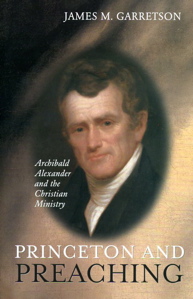
For substance, then, I turn to the men of old. Men like Charles Bridges or Thomas Boston. Or I come to a contemporary author who has laid out a ministerial feast by collating the best from a particular pastor of yesteryear. Yesterday I finished such a feast, Jim Garretson’s Princeton and Preaching: Archibald Alexander and the Christian Ministry.

The Savor of Glad Gravity

The best books on prayer are those that lead you to put down the book to scuff up your knees in the work of prayer. The best books on preaching are those that lead you to fresh zeal to ascend to the sacred desk. The best books on ministry, I’m increasingly convinced, are those that fill the soul with fearful delight regarding shepherding the flock.

The adjective of fearful is appropriate because we must daily resist the devil’s temptation merely to play at pastoring. As James said, “Not many of you should become teachers, for you will be judged all the more severely.” So, we need more fear towards the ministry than we currently have. But we also need more delight in the ministry than we currently have. To hear Christ’s call to the work of man-fishing is one of the sweetest sounds this side of heaven. It means service in the word of God and shepherding the people of God. Christ’s oxen earn their wage by preaching, praying, and pastoring. It’s as though God says, “Here, let me provide for your by commanding you to labor in joy, joy, joy.” Astonishing!

The ministry is one of fearful delight. And Garretson’s book will surely ignite every pastor’s ministry with glad gravity.

[Maybe] The Most Edifying Book I’ve Read This Year

After providing a brief biography of the first professor ever hired by Princeton Theological Seminary, Garretson proceeds to ransack Alexander’s writings for the choicest selections regarding the essentials of pastoral ministry. The great value of Alexander’s teaching is his continual emphasis on “genuine and eminent piety.” Alexander said,

Let every candidate for the ministry, then, as well as everyone that has entered it, aim at high attainments in evangelical piety. Nothing so much as this will be a pledge of eminent usefulness. Nothing else is so fruitful in expedients for doing good, or so efficient in sustaining the spirit amidst the toils of self-denying and arduous vocation, or so sure to bring down upon our labours that blessing which maketh rich.

The chapter titled, “The Preparation of the Preacher’s Heart,” is the finest I’ve every read on the subject. I found it so compelling and convicting that I’ve resolved to read it afresh each week.

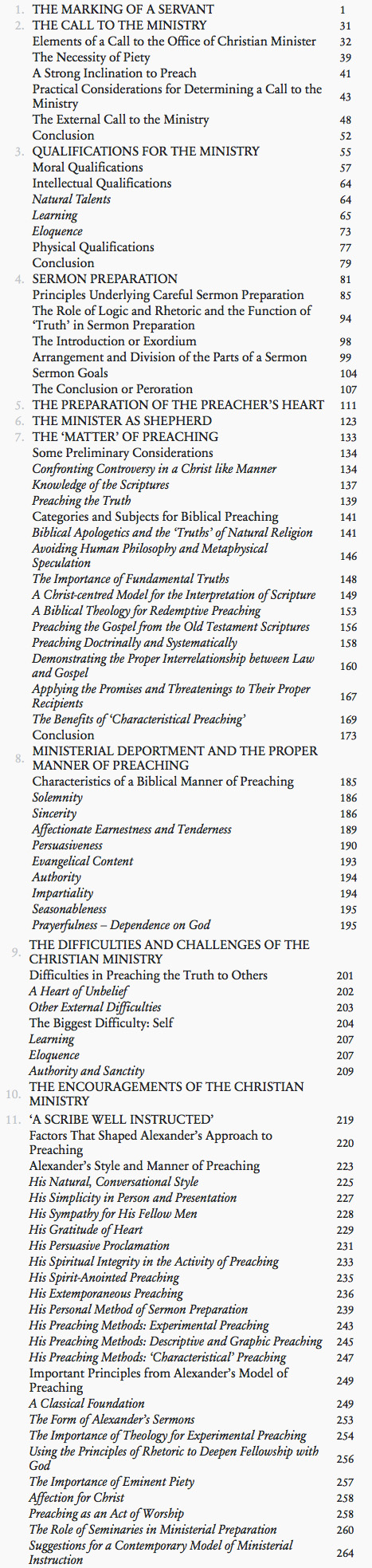
I could go on, but let me just leave you with the Table of Contents to whet your appetite for this feast. If you get Christmas money this week, set some aside to purchase a copy of Princeton and Preaching; it may just save your ministerial life.

Princeton and Preaching - Table of Contents

Nothing But Love of Christ

“Nothing but love of Christ, can make a truly faithful pastor, or evangelist, assiduous in all his services, and indefatigable in the most private and self-denying duties of his office.” – Archibald Alexander, The Pastoral Office, 8.

Training Men for Ministry

Vital Piety

I’ve spent a fair amount of time this week with the writings of Archibald Alexander, the first professor of Princeton Theological Seminary. He and a committee of men were commissioned to create a spiritual ethos in the seminary with a theological curriculum to fuel it.

What kind of atmosphere did they hope to promote? The seminary was intended to be (in the timeless words of Samuel Miller),

a nursery of vital piety as well as of sound theological learning, and to train up persons for the ministry who shall be lovers as well as defenders of truth as it is in Jesus, friends of revivals of religion, and a blessing to the Church of God.

Did you notice each part packed into that statement? Princeton Seminary was to be a place where men learned:

  • Vital piety
  • Sound doctrine
  • Love for Christ-centered truth
  • An ability to defend truth
  • Eagerness for revival
  • How to be a blessing to the church

If you’re involved in seminary administration, the application of these truths is clear enough. But what if you’re not a seminary administrator or professor? My suggestion is that you take the six points above and let them inform your goals with pastoral interns, elder candidates, or brothers in your church considering the gospel ministry.

What kind of an atmosphere are you creating in your church?

Favorite Books of 2015

Whittling down the list of books I read each year to a select few favorites is always an enjoyably difficult exercise. This year I decided to employ two criteria for my list of favorite books from 2015:

  1. Does this book have unusual benefit to ordinary pastors?
  2. Is this a book worth rereading every year?

Those two simple questions helped me pare down all the titles I’ve read to the following books, each of unique value to the ministry of ordinary pastors. Then I have three more titles worth your interest at the end.

Favorite Books for Ordinary Pastors Published in 2015

9781433547843#8—Praying the Bible by Don Whitney. Short, concise, and practical, I could see Whitney’s latest book offering wisdom many church members—and church leaders—are looking for. In Praying the Bible Whitney says, “If . . . mind-wandering boredom describes your experience in prayer, I would argue that if you are indwelled by the Holy Spirit—if you are born again—then the problem is not you; it is your method.” I think he’s right, especially when you understand the method he has in mind. The method is praying through Scripture, particularly the Psalms. He’s spot on to say that such a method of prayer gives structure, purpose, and longevity. This one could transform your prayer life.

9781433549373#7—What Does the Bible Really Teach about Homosexuality? by Kevin DeYoung. If ever there was a book uniquely suited for our time it’s DeYoung’s latest. What Does the Bible . . . ? is after an admittedly small slice of the categorical pie, for DeYoung writes, “This is a Christian book, with a narrow focus, defending a traditional view of marriage” (15). The work’s utility lies in its simplicity: part one deals with the five most debated passage on homosexuality and part two deals with the seven most common objections to the traditional view. As we should expect by now, DeYoung is winsomely logical, ruthlessly biblical, and pastorally helpful. Every pastor should have multiple copies on hand to distribute to church members.

9780310516828m#6—The Pastor Theologian by Gerald Hiestand and Todd Wilson. The Pastor Theologian well surpassed my already high expectations as the authors promote a compelling vision for recovering the long hallowed, but now forgotten, role of the pastor-theologian. Full of piercing historical and sociological analysis, rich reflection on God’s word, and surprisingly helpful tips, this is a book every pastor should read. Not all of us will become Ecclesial Theologians (the true burden of Wilson and Hiestand’s model), yet we all need fresh encouragement to zealously pursuing a learned ministry.

9780801018350m#5—The New Pastor’s Handbook by Jason Helopoulos. Believe the hype, Helopoulos’ book is indeed a “must read” for young pastors (seasoned pastors will surely benefit as well). As was the case in his first book, the instruction here is full of grace and truth. The New Pastor’s Handbook consists of forty-eight short chapters broken into five parts: The Beginning, Starting Out Strong, Encouragements, Pitfalls of Young Pastors, and Joys of Ministry. If any part is required reading it is the section on pastoral pitfalls; the one-two punch of “Taking Yourself Too Seriously” and “Not Taking Yourself Seriously Enough” hits home hard. Joe Thorn overstates his case by saying TNPH “will prove to be as helpful as The Christian Ministry by Charles Bridges.” But he doesn’t overstate the case by much, this book is that good.

#4—How to Walk Into Church by Tony Payne9781922206725m. The fact that How to Walk Into the Church is more a booklet than a book and yet still manages to rank so high on my list tells you how good I found it to be. Payne’s says we should walk into church praying about who we will sit next to. The book goes on to offer beautiful, warm, and simple counsel on the joyful necessity of gathering weekly with the church. One great thing you might do next year is get a case of this book and hand out a copy to ever family in your church. I believe How to Walk Into Church contains life-changing instruction for many ordinary Christians . . . maybe even ordinary pastors.

9780830840229m#3—Rejoicing in Christ by Michael Reeves. If there is a contemporary author I love more than Mike Reeves, I’m hard pressed to think who it could be. He’s written my favorite introduction to the Reformation, my favorite introduction to the Trinity, and with Rejoicing in Christ he’s written my favorite populary-level intro to Christology. I’m not sure, however, if this book appropriately falls into the category of “Christology.” Whenever I think of Christology, I think of textbook-ish works on the hypostatic union, eternal generation, and the like. Those volumes are vital indeed; we also need books that simply show us how to stare at Jesus—and do so with joy and hope! Rejoicing in Christ models exultational Christology at its finest.

9781433543548m#2—The Compelling Community by Mark Dever and Jamie Dunlop. Dever’s book The Deliberate Church is the resource, outside of Scripture, we value most when training future officers at IDC. It offers an astonishing amount of biblical truth and practical wisdom on matters of pastoral ministry, church polity, corporate worship, and even gets down to things like hiring church staff and running elders’ meetings. Whereas The Deliberate Church aims to set a foundation for a healthy church, The Compelling Community is something like a sequel that tries to let us know—as difficult as it can be to capture in print—what a healthy church feels like. And what a fantastic sequel this is! The Compelling Community offers a vision for healthy church life from which any pastor or church leader can profit. I found the discussion of a church being a place of either “Gospel Plus Community” or “Gospel Revealing Community” worth its weight in gold. I’ll cast aside all other superlatives that come to my mind and simply say, “Get this book!”

9781848716308m#1—Knowing Christ by Mark Jones. If Helopoulos’s book is a modern version of Bridges’ The Christian Ministry then Mark Jones’ latest is a modern-day The Glory of Christ by John Owen. Knowing Christ is devotional Christology par excellence. Those familiar with Jones will know he is a faithful guide on the Christological paths; he employs the full range biblical theology, systematic theology, and historical theology (especially the Puritans) to make the heart happy in Christ. This is not a book to read quickly; I’d recommend reading one chapter during each day’s daily devotions. I was regularly so moved at the glories of Christ that I had to put the book down to contemplate, pray, and worship. May this book receive the widest audience possible.

Favorite Book for Ordinary Pastors Not Published in 2015

Words to Winners of Souls0875521649m by Horatius Bonar. How I’ve made it over a decade in ministry without reading Bonar’s classic is a mystery to me. The influence of the tiny island of Scotland on the Christian history is stunning. And most of it stems from the view of ministry that has permeated its pastors for centuries. In Words to Winners of Souls Bonar casts a vision for gospel ministry that is simultaneously comforting and convicting. Perhaps the greatest section of the book isn’t even written by Bonar. In 1651, a collection of pastors in Scotland came together a drew up “an humble acknowledgment of the sins of the ministry.” They sensed God’s judgment upon the country and viewed themselves as no small part of the problem. Horatius Bonar called the subsequent ministerial confession “one of the fullest, most faithful and most impartial confessions of ministerial sin ever made.” Read this and don’t be surprised if you weep for greater faithfulness in stewarding the gospel.

Favorite Non-Fiction Book

513F52vnKLL._SX341_BO1,204,203,200_The Wright Brothers by David McCullough. There isn’t anyone from whom I’d rather learn about American history than David McCullough. The two-time Pulitzer winner writes with such a warmth and familiarity of understanding I feel as though I’m listening to my grandfather tells stories of days gone by. His latest work focuses on how Wilbur and Orville Wright created their “flying machine.” This story of the boys from Dayton, Ohio is quintessentially “American”—two men rising from obscurity to change the world through undaunted industry and ingenuity. The Wright Brothers is a story we all should know. And McCullough’s reverent and beautiful prose is the perfect guide.

Favorite Fiction Book

BTThe Bone Tree by Greg Iles. I loved Iles’ Natchez Burning so much that I named it my favorite fiction book of 2014. Natchez was the first book in a trilogy and ever since reading it I’ve tried to temper my expectations for its sequel, The Bone Tree. I am delighted to say there was no need for such tempering; The Bone Tree is excellent! Iles picks up right where the narrative left off and for 800 pages, with unrelenting force, he never lets the reader go. The pages fly as Penn Cage tries to save his father, uncover the truth about Kennedy’s assassination, and take justice into his hands when he loses a loved one. I was shocked to see just how many loose ends Iles tied up from Natchez while simultaneously opening up new ones that will make any reader ravenous to read the trilogy’s final entry.

Click here to see my Favorite Books of 2014 and Favorite Books of 2013.

The End of *Regular* Blogging

Blogging Resignation

Back in the early 1990s a popular quartet of crooners sang, “We’ve come to the end of the road.” For some reason, that swan song rings in my ears as I tell you, my faithful few readers, that my regular blogging has reached its end.

Writing to Think

I began filling up this space with ruminations on all things related to ordinary ministry back in September 2013. The main reason for starting the blog was sheer selfishness—I wanted to write. Not necessarily because I thought I had any peculiar wisdom about praying, preaching, and pastoring. In fact, quite the opposite was true: I was eight months into my first senior pastorate and needed to figure out what I should be doing. I count myself among those who write to know. It’s only when I write that I figure out the logic and look of a particular truth.

And so I wrote. And certain convictions found a home in my ministerial heart.

Now, 649 posts later, I’m putting down the pen. Why?

In Search of a Ph.D. and Permanence

My essential reasoning for stepping away from this here blogosphere is due to requirements at The Institution. If I’m ever going to write a doctoral dissertation, well, I need to start writing one. For some reason—probably due to the exhaustive nature of research writing—I gravitate more towards writing in this space than in those hallowed halls of academia. Excising blog writing means gaining back several hours each week for dissertation writing. My family rejoices at the reception of those hours for, Lord willing, that means a husband and daddy will graduate sooner. And “The M’Cheyne School of Pastoral Ministry” rejoices because someone finally gives them the academic treatment they deserve (assuming, of course, the Lord or my advisor doesn’t change my dissertation topic).

Although it’s the paramount reason, writing about 19th century Scotsmen is not the only reason for this here notification of termination. I’m longing to finish the Ph.D. and direct my writing efforts to matters of permanence.

If I’ve learned anything over the last two-plus years, it’s that blogging is the quintessence of ephemeral writing. Like vapors in the wind do blog posts fly. That’s not to say blog posts have no merit. If Mr. M’Cheyne weren’t ringing at the door each week, I’d be happy to keep up the mutterings and the musings. But, we must admit, blog posts don’t—by their very nature—have the sustaining power of books. So when I speak of permanence I speak of writing more for the printed page.

Writing with [More] Permanent Ink

I have a folder full of book projects, and the first is—you may have guessed already—that lovely dissertation. The second one may surprise you, though: an autobiography. Yes, all you misters and madams, I’m writing an autobiography! And I don’t expect any of you will see it.

A long-offered prayer of mine is that the Lord would exalt His Son in unusually powerful ways through my family. I long for the gates of hell to quake at the mention of a Stone son or daughter rising with the gospel. I want the demons to say, “Jesus I know, and the Stones I recognize” (Acts 19:15). Four years ago I began an autobiography that I hope will not only encourage generations of Stones to “go and do likewise,” but will also show them where they should “go and do otherwise.”

Should the Lord be kind to let me finish the dissertation and catch up on my first thirty-one years of life, I hope to turn then my attention to a few topics and truths burning in my soul. The best writers burn from the truth and for the truth and strive not to burn out in the labor. I don’t want to burn out here and not be able to burn there. So, I tender my resignation.

A Ghost in the House

I imagine I will still haunt this space from time to time. As much as my routine-driven mind would like to tell you how often (like at least one post a month) my ghost will show up, I’ll refrain from any assurance lest I bind my conscience and have to add an addendum to my resignation. The only parting promise I give is that in the next 7–10 days I will offer a post on “Favorite Books of 2015.” Just today I finished book #182 for the year, and I’m eager to let you now which ones might be especially helpful for ordinary pastors.

The grace of the Lord Jesus Christ be with your spirit.
To our God and Father be glory forever and ever. Amen.

Questions that Need Answering

Deviantart-please-stand-by-by-gxmew

I’m signing off the blog for a period of time once again. PhD assignments for the fall semester are reaching crunch time and need more attention than I’ve been giving them. Also, I have many theological and pastoral questions I need to wrestle with. They have nagged me for too long and must finally be confronted. Should you think about it in the next few weeks, I’d appreciate prayer.

I hope to be back around Thanksgiving.

A Ministry Confessional

Confession Of Sin

In 1651 a collection of pastors in Scotland came together a drew up “an humble acknowledgment of the sins of the ministry.” They sensed God’s judgment upon the country and viewed themselves as no small part of the problem. Horatius Bonar called the subsequent ministerial confession “one of the fullest, most faithful and most impartial confessions of ministerial sin ever made.”

I’d have to agree with Bonar—I’ve never read anything like this before yesterday. Rarely could I go a few sentences into the document without pausing to examine my own life and repent of sin (it thus took a long time to get through it!). I’ve copied a substantial excerpt below and encourage you to read prayerfully and humbly. It may just be the most challenging reading you encounter this week.

Before Entering the Ministry

Lightness and profanity in conversation, unsuitable to that holy calling which they strove for, not thoroughly repented of. Not studying to be in Christ before they be in the ministry; nor to have the practical knowledge and experience of the mystery of the gospel in themselves before they preach it to others. Neglecting to fit themselves for the work of the ministry, in not improving prayer and fellowship with God, opportunities of a living ministry, and other means, and not mourning for these neglects. Not studying self-denial, nor resolving to take up the cross of Christ. Negligence to entertain a sight and sense of sin and misery; not wrestling against corruption, nor studying mortification and subduedness of spirit.

Entering the ministry without respect to a commission from Jesus Christ, by which it hath come to pass that many have run unsent. Entering the ministry not from the love of Christ, nor from a desire to honor God in gaining of souls, but for a name and for a livelihood in the world, in spite of a solemn declaration to the contrary when they became a minister.

After Entering the Ministry

Ignorance of God; lack of nearness with Him, and taking up little of God in reading, meditating, and speaking of Him. Exceeding great selfishness in all that we do; acting from ourselves, for ourselves, and to ourselves. Not caring how unfaithful and negligent others were, so being it might contribute a testimony to our faithfulness and diligence, but being rather content, if not rejoicing, at their faults. Least delight in those things wherein lieth our nearest communion with God; great inconstancy in our walk with God, and neglect of acknowledging Him in all our ways. In going about duties, least careful of those things which are most remote from the eyes of men. Seldom in secret prayer with God, except to fit for public performance; and even that much neglected, or gone about very superficially.

Glad to Find Excuses

Glad to find excuses for the neglect of duties. Neglecting the reading of Scriptures in secret, for edifying ourselves as Christians; only reading them just enough to do our duty as ministers, and ofttimes neglecting even that. Not given to reflect upon our own ways, nor allowing conviction to have a thorough work upon us; deceiving ourselves by resting in the fact that our hard conscience does not bother us, and looking upon the same as an evidence of a real change of state and nature.

Poor guarding of and watching over the heart, and carelessness in self-searching; which makes much unacquaintedness with ourselves and creates separation from God. Not guarding nor wrestling against seen and known evils. Easily drawn away with the temptations of the time, and other particular temptations, according to our inclinations and fellowship.

Instability and wavering in the ways of God, through the fears of persecutions, hazard, or loss of reputation; and declining duties because of the fear of jealousies and reproaches. Not esteeming the cross of Christ and sufferings for His name as honorable, but rather escaping from sufferings, due to self-love. Deadness of spirit, even after all the sore strokes of God upon the land. Little conscience made of secret humiliation and fasting, by ourselves apart and in our families, that we might mourn for our own and the land’s guiltiness and great backslidings; and little applying of public humiliation to our own hearts. Finding of our own pleasure, when the Lord calls for our humiliation.

Not laying to heart the sad and heavy sufferings of the people of God abroad, and the nonthriving of the kingdom of Jesus Christ and the power of godliness among them. Refined hypocrisy; desiring to appear what, indeed, we are not. Studying more to learn the language of God’s people than their practice. Artificial confessing of sin, without repentance; professing to expose iniquity, and not resolving to be sorry for sin. Confession in secret much slighted, even of those things whereof we are convicted. No reformation, after solemn acknowledgments and private vows; thinking ourselves exonerated after confession. Readier to search out and censure faults in others than to see or deal with them in ourselves. Accounting of our condition and way according to the estimation that others have of us. Our estimation of men depends on whether they agree with us or not.

Not fearing to meet with trials, but presuming, in our own strength, to go through them unshaken. Not learning to fear, by the falls of gracious men; nor mourning and praying for them. Not pointing out particular deliverances and punishments; not learning from them, for the honor of God and the edification of ourselves and others. Little or no mourning for the corruption of our nature, and less groaning under, and longing to be delivered from that body of death, the bitter root of all our other evils.

Fruitless conversations with others, for the worse rather than for the better. Foolish jesting away of time with impertinent and useless discourse, very unbecoming the ministers of the gospel. Spiritual purposes often dying in our hands when they are begun by others. Carnal familiarity with natural, wicked, and malignant men, whereby they are hardened, the people of God stumbled, and we ourselves blunted.

Loving Pleasure More than God

Slighting of fellowship with those by whom we might profit. Desiring more to converse with those that might better us by their money than with such as might edify us by their graces. Not studying opportunities of doing good to others. Shifting of prayer and other duties, when called thereto—choosing rather to omit the same than that we should be put to them ourselves. Abusing of time in frequent recreation and pastimes and loving our pleasures more than God. Taking little or no time to Christian discourse with young men trained up for the ministry. Common and ordinary discourse on the Lord’s Day. Slighting Christian admonition from any of our flocks or others, as being below us; and ashamed to take light and warning from private Christians. Dislike of, or bitterness against, such as deal freely with us by admonition or reproof, and not dealing faithfully with others who would welcome it off our hands.

Not praying for men of a different opinion, but using reservedness and distance from them; being more ready to speak of them than to them or to God for them. Not weighed with the failings and miscarriages of others, but rather taking advantage thereof for justifying ourselves. Talking of and sporting at the faults of others, rather than compassionate toward them. Not taking pains in religious ordering of our families, nor studying to be patterns to other families in guiding ours. Hasty anger and passion in our families and conversation with others.

Covetousness, worldly-mindedness, and an inordinate desire after the things of this life, upon which followeth a neglect of the duties of our calling, and our being taken up for the most part with the things of the world. Lack of hospitality and charity to the members of Christ. Not cherishing godliness in the people; being afraid of it and hating the people of God for piety, and studying to bear down and quench the work of the Spirit amongst them.

Trusting in Our Own Ability

Not entertaining that edge of spirit in ministerial duties which we found at the first entry to the ministry. Great neglect of reading, and other preparation; or preparation merely literal and bookish, making an idol of a book, which hinders communion with God; or presuming on bygone assistance, and praying little. Trusting to gifts, talents, and pains taken for preparation, whereby God is provoked to blast our good topics, even though they are so well-ordered and worded. Careless in employing Christ and drawing virtue out of Him, for enabling us to preach in the Spirit and in power. In praying for assistance we pray more for assistance to the messenger than to the message which we carry, not caring what becomes of the Word. Neglect of prayer after the Word is preached.

Neglect to warn, in preaching, of snares and sins in politics; and too much, too frequent, and unnecessary speaking by others of public business and transactions. Exceeding great neglect and unskillfulness to set forth the excellences and usefulness of (and the necessity of an interest in) Jesus Christ, and the new covenant, which ought to be the great subject of a minister’s study and preaching. Speaking of Christ more by hearsay than from knowledge and experience, or any real impression of Him upon the heart. The way of most ministers’ preaching is too legal. Lack of sobriety in preaching the gospel; not savoring anything but what is new; so that the fundamentals of religion bear but little bulk.

Not preaching Christ in the simplicity of the Gospel, nor ourselves the people’s servants, for Christ’s sake. Preaching of Christ, not that the people may know Him, but that they may think we know much about Him. Preaching about Christ’s leaving of the world without brokenness of heart, or stirring up of ourselves to take hold of Him. Not preaching with bowels of compassion to them that are in danger of perishing. Preaching against public sins, neither in such a way, nor for such an end, as we ought—for the gaining of souls and drawing men out of their sins; but rather because it is to our advantage to say something of these evils.

Attitude Toward Our Opponents

Bitterness, instead of zeal, in speaking against evil people, sectarians, and other scandalous persons. Not studying to know the particular condition of the souls of the people, that we may speak to them accordingly; nor keeping a particular record thereof, though convinced of the usefulness of this. Not carefully choosing what may be most profitable and edifying; and lack of wisdom in application to the several conditions of souls; not so careful to bring home the point by application.

Choosing texts whereon we have something to say, rather than those suited to the conditions of souls and times, and frequent preaching of the same things, that we may not be put to the pains of new study. Such a way of reading, preaching, and prayer as puts us in these duties farther from God. Too soon satisfied in the discharge of duties, and holding off challenges of conscience with excuses.

Indulging the body, and wasting much time idly. Too much eyeing our own credit and applause; and being pleased with it when we get it, and unsatisfied when it is lacking. Fearfulness in delivering God’s message; letting people die in reigning sins without warning. Studying the discharge of duties rather to free ourselves from censure than to approve ourselves to God.

Not making all the counsel of God known to His people; and particularly, not giving testimony in times of defection. Not studying to profit by our own doctrine, nor the doctrine of others. For most part, preaching as if we ourselves were not concerned in the message which we carry to the people. Not rejoicing at the conversion of sinners, but content with the unthriving of the Lord’s work amongst His people, as suiting best with our minds; fearing, if they should thrive better, we should be more put to it, and less esteemed of by them.

We preach not as before God, but as to men; as doth appear by the different pains in our preparation to speak to our ordinary hearers and to others to whom we would approve ourselves. Negligent, lazy, and partial visiting of the sick. If they be poor we go once, and only when sent for; if they be rich and of better note, we go oftener and unsent for. Not knowing how to speak with the tongue of the learned a word in season to the weary.

Lazy and negligent in catechising. Not preparing our hearts before, nor wrestling with God for a blessing to it, because of the ordinariness and apprehended easiness of it; whereby the Lord’s name is much taken in vain, and the people little profited. Looking on that exercise as a work below us, and not condescending to study a right and profitable way of instructing the Lord’s people. Partial in catechising, passing by those that are rich and of better quality, though many of these stand in great need of instruction. Not waiting upon and checking up on the ignorant, but often passionately upbraiding them.


Stunned by the Son

Philippians Podcast

Three weeks ago I was in Athens, Greece with one of our Gospel Partners. Saturday morning’s schedule was free from commitments so we traveled out to the Areopagus and climbed up Mars Hill, the great setting for Paul’s confronting the Greeks with the gospel in Acts 17. The hike up was more strenuous then I imagined and when we reached the top I remember standing somewhat breathless—mostly in awe. The historical significance of city, the contemporary views of beauty, and the depth of meaning this mountain has to our understanding of God coalesced in together that moment and I found my soul stunned in wonder.

I believe God desires to do the exact same thing with us as we stare at this summit of truth about Jesus in Philippians 2:5-11. Dennis Johnson says, “This passage is . . . a majestic mountain peak, towering over the surrounding countryside. It is a pinnacle of theological truth, piercing the heavens and probing the mystery of the incarnation.” Alec Motyer writes, “[Here] we tread . . . on very holy ground indeed. We do well to remember that this privilege is given to us not to satisfy our curiosity but to reform out lives.” Gordon Fee agrees when he comments, “[This is] a passage that should cause the reader to soar.”

But let’s remember, this deep theological hymn is meant to fuel a particular practice in our life as a church: joyful unity. So let’s consider a couple ways to cultivate humility in our lives, according to our text.

Behold the glory of Christ. It begins here, it always begins here. We must load our minds with the glory of Christ in order to live for the glory of Christ. Where in your week are you devoting time to see and savor the glory of Christ? Maybe it’s personal times of devotion, small group, another discipling relationship, but how I long you might see gathered worship as God’s ordinary, ordained place to see the glory of His Son. It’s not legalism to say you must be doing it; we need the cultivation of desperation in our lives for to live we must look upon His glory. Which leads to the second point . . .

Believe the gospel of Christ. We don’t want to merely behold the glory of Christ in the gospel, we want to believe it. Jesus came to saves sinners like you and me. How’d he do it? By obeying to the point of death, even death on a cross. He now sits on high reigning in power, calling out through His word and Spirit, “Believe in me! Find your sin forgiven, your penalty of eternal death removed, and receive eternal life.” If you’re in hear tonight and are not a Christian I want you to feel the urgency of this gospel call. For 2:10-11 says every knee will bow and every tongue will confess that Jesus is Lord. There is thus an eternal urgency before you in this text:

  • Bow the knee today = salvation
  • Bow the knee then = condemnation.

Will you believe today?

Be like the Lord Jesus Christ. This is Paul’s essential point: imitate Jesus’ example of humility. Be like him. Imitation may have fallen on hard times in some circles of Christianity, but it is oh so biblical. The pattern of our Lord is to be our pattern, humiliation now and exaltation then; humility now and glory then.

The first order of life in a faithful church, Paul says, is living worthy of the gospel of Christ; worthy living that is best seen by walking in humble unity. The struggle for humility for many of us is the hardest fight in the Christian life. And so Paul serves us by saying, “Look at the example of Christ; have that mind among you.” Joyful humility comes from seeing and savoring the example of Jesus Christ.

This post is adapted from my recent sermon, “Rejoicing in Jesus,” on Philippians 2:5-11.