But carry to the pulpit . . . well-digested thoughts, with suitable words to express them – written in your inmost soul, and if needful also in your manuscript – thoughts and words wherewith to stir the souls of your hearers to their inmost depths, – wherewith to hold living conversation with them, and tell them what God has been telling you; and both you and they shall find that the Pulpit still wields a power all together its own.
A Gospel-Hymn
Songs have power. When they carry the gospel, they can become instruments of conversion. Consider the case of Charles Wesley’s “Arise, My Soul, Arise.”
A Wesleyan missionary laboring in the West Indies once wrote, “I have a record of two hundred persons, young and old, who received the most direct evidence of the forgiveness of their sins while singing ‘Arise, My Soul.’ The conversion of the greater number of these persons took place while I was a missionary abroad.”
If you are looking for a rich, gospel-hymn to add to your church’s repertoire consider this class from Wesley. Here are two popular variations:
INDELIBLE GRACE STYLE
LYRICS
VERSE 1
Arise, my soul, arise,
shake off your guilty fears;
The bleeding sacrifice,
in my behalf appears;
Before the throne my Surety stands,
My name is written on His hands.
CHORUS
Arise (arise), arise (arise), arise
Arise, my soul, arise.
Arise (arise), arise (arise), arise
Arise, my soul, arise.
Shake off your guilty fears and rise
VERSE 2
He ever lives above,
for me to intercede;
His all redeeming love,
His precious blood, to plead;
His blood atoned for every race,
And sprinkles now the throne of grace.
VERSE 3
Five bleeding wounds He bears;
received on Calvary;
They pour effectual prayers;
they strongly plead for me:
“Forgive him, O forgive,” they cry,
“Nor let that ransomed sinner die!”
VERSE 4
The Father hears Him pray,
His dear anointed One;
He cannot turn away
the presence of His Son;
The Spirit answers to the blood,
The Spirit answers to the blood
And tells me I am born of God.
VERSE 5
My God is reconciled;
His pardoning voice I hear;
He owns me for His child;
I can no longer fear
With confidence I now draw nigh,
And “Father, Abba, Father,” cry.
T4G STYLE
LYRICS
VERSE 1
Arise, my soul, arise; shake off thy guilty fears
The bleeding sacrifice in my behalf appears
Before the throne my surety stands
My name is written on His hands
VERSE 2
Five bleeding wounds He bears, received on Calvary
They pour effectual prayers; they strongly plead for me
“Forgive him, oh forgive,” they cry
“Nor let that ransomed sinner die!”
VERSE 3
The Father hears Him pray, His dear Anointed One
He cannot turn away the presence of His Son
His Spirit answers to the blood
And tells me I am born of God
VERSE 4
My God is reconciled; His pardoning voice I hear
He owns me for His child; I can no longer fear
With confidence I now draw nigh
And “Father, Abba, Father” cry
Looking for Elders
It is the sine qua non of eldership in a local church: “He must be able to teach.” That aptitude singles a man out for shepherding service in a way no other qualification does.
Therefore, discerning a man’s aptitude to teach is always of utmost importance.
WHAT DOES IT MEAN?
No small amount of ink has been used to define what it means for a man to “be able to teach,” but thankfully we really don’t need to get ourselves into a tizzy trying to interpret the phrase. Paul functionally defines the qualification in his parallel instruction to Titus. In Titus 1:9 he writes, “He must be able to give instruction in sound doctrine and also to rebuke those who contradict it.” That’s it: he must be faithful in instruction and refutation. Not one or the other, but both.
9 CONSIDERATIONS FOR FINDING TEACHERS
The question then becomes, “How do we find these faithful teachers?” In his wonderfully wise book Finding Faithful Elders and Deacons Thabiti Anyabwile gives the following nine considerations:
- Pastors must look for ways to provide men in the church opportunities to teach in order to assess giftedness and ability.
- Assuming a man has had a number of opportunities to teach, how capable is he?
- Does the man show pastoral sensibility in his teaching?
- Is the prospective elder committed to exposition (or the church’s preaching philosophy)?
- Are others edified by his teaching?
- Does the man disciple others?
- Is the man theologically mature and supportive of the church’s theological distinctives?
- Can the prospective elder defend the faith?
- Is the man himself teachable?
Yes and amen to each one.
HIS CONVERSATION IS SATURATED WITH SCRIPTURE
The older I get the more I’m convinced there is another consideration we must keep in mind when looking for potential elders: Does he speak with the language of Scripture in ordinary conversation? Yes, a man’s aptitude to teach is so easily seen in his preaching, but many elders – particularly lay elders – will do most of their teaching in a conversational or dialogical contexts. And what we want are men, like good Mr. Bunyan, that we can prick anywhere and increasingly find their blood to be “bibline.”
We should then ask questions like: Does the man answer common questions with relevant quotations and applications from Scripture? Or is his counsel largely taken from personal observation on the world and experience? Can he naturally converse about the things of God? And does his involvement in such conversation reveal a depth of understanding uncommon to the average church member? Or does he reveal a lack of familiarity with God’s word by its ordinary absence in his common conversations?
The man must be Bible-man in every station and with every person. And I just think if he is indeed gifted with skill in instruction and refutation (Titus 1:9) we would see it and hear it.
Could it be that a man’s ability to speak Scripturally is the initial non-negotiable of the elder’s sine qua non?
Logic and Lament
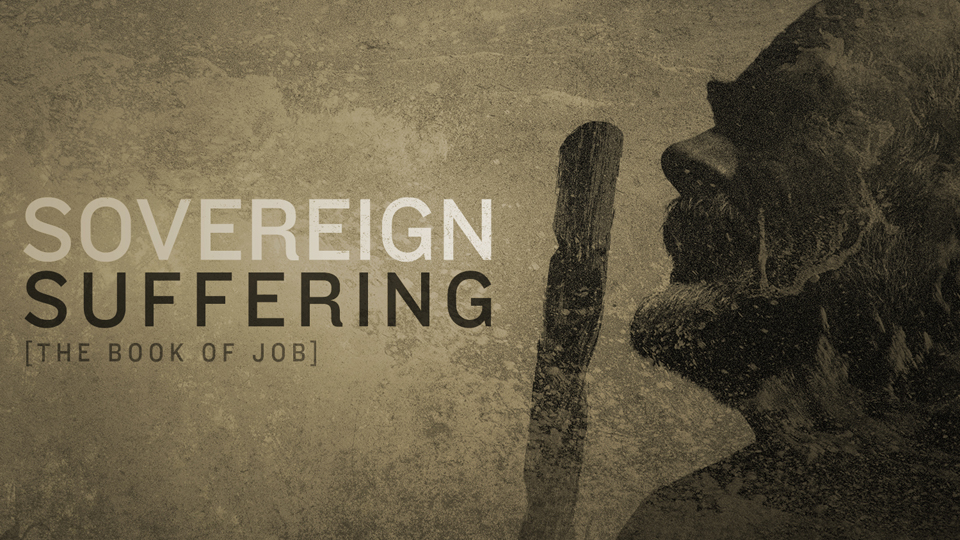
What do we learn from this first interchange between Job and Eliphaz in Job 4-7?
Epliphaz said, “Innocent people don’t suffer (4:7). Therefore, Job you must be guilty of something. Be sensible, be humble. Despise not God’s discipline.” To which Job responds, “Oh, that God will give me death (6:8-9)! I am just a meaningless string floating in the universe and I wish God would take his sovereign scissors and cut me off. And why won’t my friends give me comfort (6:14)? Why have I become such a burden to God (7:20)? If I have sinned why won’t He just forgive me and restore me?”
One thing we see this conversation is that there are two ordinary ways in which humanity ordinarily speaks in suffering.
SPEAKING IN SUFFERING
You can speak in suffering with the language of logic. Eliphaz looks at Job, looks at the world, and shows, through his counsel, that logic rules everything in his mind. Logic is not a wrong in and of itself, but it can’t live in a straightjacket. Eliphaz is like a person who goes into a homeless shelter and automatically assumes everyone in attendance has deserved the hardship of homelessness. So there’s the language of logic and then there’s . . .
You can speak in suffering with the language of lament. Job is once again showing us that we must have a place in our lives for lament, for sorrow and weeping at pain. Job doesn’t remove logic from the equation, instead he displays what logical lamentation looks like. He knows he’s done nothing wrong and so cries, “Oh God, why? Why this anguish? Take it from me!”
When was the last time you sat down next to someone in the midst of suffering? What words dominated your counsel? Straightjacket logic or comforting lament?
Two Saturdays ago, after gathered worship, Emily and I drove up to Breckenridge, Colorado. Driving through the night was best for a variety of different reasons, but it meant that some of the scenic views were out of view in the darkness of the night. So, as we drove through the day on the way back I kept thinking, “Oh wow, this is incredible, I didn’t see this sight on the way up!”
And we can fall into a similar experience with Job. This book is preeminently about how a sovereign God reigns over the suffering of His people. Our journey through Job can be like a drive in the night, one that misses the beauties of God. Or we can drive through it with the Spirit’s light and find incredible riches for our feasting. So as we begin to close, let me highlight three truths, from our text, about our great God.
BEHOLD OUR GREAT GOD
God’s wrath is unbearable. In 6:4 Job says,
For the arrows of the Almighty are in me;
my spirit drinks their poison;
the terrors of God are arrayed against me.
Job believes that he is suffering under the wrathful judgment of God and he can’t take it. He is suffering and cries out in anguish for God to finish him off! Oh, how much more terrifying is the wrath of God which falls for eternity on those apart from Christ. What will you do with this wrath of God? Disagree with it? Apologize for it? Or flee to the only refuge from it – the Lord Jesus?
God’s ways are unsearchable. God is doing something through this suffering that Job, and none of his friends, can understand. His thoughts are higher than their thoughts, ways beyond their understanding. The Lord moves in mysterious ways, His wonders to perform. Do you have a biblical understanding of a God so great and glorious, beyond comparison, that it’s impossible for your finite mind to comprehend his infinitely wise ways? If not, the God you praise is smaller than the God of Scripture.
God’s worth is invaluable. Lest we think Job’s desire for death is merely the removal of pain, notice what Job says in 6:10,
This (death) would be my comfort;
I would even exult in pain unsparing,
for I have not denied the words of the Holy One.
“Like a prisoner undergoing torture and would rather die than eventually break, so does Job long to die without betraying his faith in the goodness of God.”1 I heard a preacher recently says, “A church that would rather die than disobey is unstoppable.” And I think that’s absolutely right and captures something of the power of Job. Eliphaz says, “Innocent people don’t suffer.” Job knows he suffers innocently and is desperate, even if it means dying, to magnify the unending worth of God. Will you magnify God even if you suffer innocently?
- Ash, 123 ↩
Pastors Need Prayer
John Newton is a pastoral counselor par excellence. One only needs to read his letters to see uncommon wisdom and skill in using the balm of Scripture.
Preachers all across the world will ascend to the sacred desk this morning and will plead with people to cling to Christ. Their pleading will need power. An old letter from Newton humbly captures this posture we ought to always have when preaching:
I trust I have a remembrance in your prayers. I need them much: my service is great.
It is, indeed, no small thing to stand between God and the people, to divide the word of truth aright, to give every one portion, to withstand the counter tides of opposition and popularity, and to press those truths upon others, the power of which, I, at times, feel so little of in my own soul. A cold, corrupt heart is uncomfortable company in the pulpit.
Yet in the midst of all my fears and unworthiness, I am enabled to cleave to the promise, and to rely on the power of the great Redeemer.
I know I am engaged in the cause against which the gates of hell cannot prevail. If He died and rose again, if He ever lives to make intercession, there must be safety under the shadow of his wings: there would I lie.
In his name I would lift up my banner; in his strength I would go forth, do what He enables me, then take shame to myself that I can do no better, and put my hand upon my mouth, confessing that I am dust and ashes—less than the least of all his mercies.
May preachers all across the world preach today in such prayerful dependence.
Recent Reads
I love to read. By God’s grace I am a pretty fast reader; I usually read a couple books each week. I find it helpful to summarize my thoughts on each book and I offer those thoughts in the hope that you will be encouraged to either read or pass over the given title.
God’s Forever Family: The Jesus People Movement in America by Larry Eskridge. For two and a half years during high school I attended a Calvary Chapel in Sarasota, Florida. It was an utterly unique experience for me; casually dressed pastors preached through books of the Bible and men with guitars led corporate singing that consisted mostly of contemporary songs of praise. It was all very different from my traditional Southern Baptist upbringing. In time I learned how the Calvary Chapel movement descended from Chuck Smith and the Jesus People movement of the late 1960s and early 1970s. So when I saw, late last year, that evangelical historian Larry Eskridge published a book detailing the history and influence of the Jesus People movement I knew I had to read it. God’s Forever Family is book every pastor should consider reading if he wants to better understand the current landscape of evangelicalism.
Eskridge’s able recounting of the movement’s movers and leaders is fascinating on a historical level. Stories of communes, coffee houses, rock bands, musicals, The Late Great Planet Earth, and hippie Christians make the book interesting even for casual readers. But the huge payoff comes in the final chapter where Eskridge evaluates “The Long-Term Impact of the Jesus People Movement.” He identifies three primary categories of the movement’s long-term impact and influence: music, popular youth culture, and church life. The primary takeaway for today’s pastor is how the Jesus People served as a catalyst for modern evangelicalism’s infatuation with “youth culture.” One reviewer wisely concludes, “When worship looks and sounds like youth group, the church is in danger of being led astray. The church needs youthful energy and boldness, but it also needs the experience and wisdom of older brothers and sisters who find themselves alienated from many evangelical congregations.” Amen. Any pastor would benefit greatly from Eskridge’s excellent work.
Yawning at Tigers: You Can’t Tame God, So Stop Trying by Drew Dyck. After reading the first three chapters of Yawning at Tigers I was about ready to proclaim it as a modern version of Sproul’s The Holiness of God. Dyck is an excellent writer and his presentation of the Almighty is brilliant. Consider his comments on the scene at Sinai in Exodus:
[Exodus 19:16-19 is] a powerful scene, one that underscores God’s holiness and majesty. It’s also absolutely terrifying. After such an overwhelming encounter, I wonder if the idea of a mute idol seemed strangely attractive – for comfort if nothing else.
Here the contrast between God and an idol couldn’t be clearer. We’re told that after offering sacrifices to the golden calf, the Israelites ‘sat down to eat and drink and got up to indulge in revelry’ (Ex. 32:6). But when God descended on Mount Sinai ‘everyone in the camp trembled’ (Ex. 19:16). You don’t tremble before an idol.
Now that’s good. Yet, from chapter four on I found Dyck’s argumentation less compelling as he slides into more comfortable evangelical language about God’s holiness and love. Maybe my decreased enthusiasm is his tendency to over-illustrate; at least half the book is anecdotal or illustrative. Or maybe it’s how he can quote John Calvin in one sentence and John Eldridge in the next with equal favor. Don’t get me wrong, the book is solid. I bet my sense of disappoint largely stems from the incredibly high – and probably unrealistic – expectations those first three chapters created.
Burning Hearts: Preaching to the Affections by Josh Moody and Robin Weekes. I love books like this one; short volumes that simply address one aspect of faithful proclamation. Moody and Weekes have a burden to see pastors effectively target their congregation’s heart – i.e. affections – in preaching. They define preaching as “the God-ordained means by which He meets with His people through His word and by His Spirit in such a way that His people’s eyes are opened to see Jesus and be captivated by Him” (25). For just over sixty-five pages the authors cover the what, why, and how of preaching to the affections; this is a quick and edifying read. The book’s usefulness is greatly multiplied in the final four chapters where the authors reproduce a sermon manuscript and then comment on its effectiveness in reaching the affections. Carson’s endorsement is a healthy summary, “For some, this will be a healthy reminder; for others, it will revolutionize their preaching.”
Click here to find other entries in the Recent Reads series.
14 Prayers for Godliness
For well over a year Willem Teellinck’s The Path of True Godliness sat patiently on my shelf waiting to be read. Earlier this week Teellinck’s treatise finally got the nod and so far the book is outstanding.
In his introduction to Teellinck’s life and ministry Joel Beeke writes, “People were drawn to his ministry by his sincere conversation and preaching, faithful visiting and catechizing, godly walk and selfless demeanor, and simple practical writings. He demonstrated the conviction that a pastor ought to be the godliest person in the congregation.” That final sentence resonates with me:
“The pastor ought to be the godliest person in the congregation.”
HOLY ASPIRATION
I don’t worry so much about whether or not the pastor is the godliest person in the congregation, but if he aspires and strives for supreme holiness in all things. As M’Cheyne famously said, “A holy minister is an awful weapon in the hands of the Lord.” I so desperately want to be an sharp sword or pointed arrow with which God assaults his vaunted foes fortress of darkness.
An ordinary overflow of that aspiration should be a life of prayerful pleading for God to increase one’s holiness. I am therefore always on the lookout for anything that provides new and specific fervor to my prayers for holiness. Teellinck’s book has already given me a plethora of new points in my prayers for godliness.
In “Book 1” he gives fourteen aspects of godliness’ true character. Simple, yet profound, these point were great encouragements to me, so I ended up personalizing them into items of prayer. Maybe they will be of help for your ministry and life of prayer.
PRAYING FOR GODLINESS
- Help me to increasingly believe in You and Your Son; to fear You, love You, and cling to You.
- Compel me to pray persistently, read Your Word diligently, to meditate on it, to keep it in my heart, to speak about it, and to glorify You and praise You in song.
- Make me meek and patient in everything You have me do.
- Let me remember and keep your holy day of rest.
- May I love the regular assembling of Your church.
- Give me a heart for the concerns and causes of Your people.
- Let my heart be one of humility, one that mourns for not only my own sins but also for those of the nation and to rejoice greatly we Your Spirit moves in powerful progress.
- Guide me to show love to my neighbors, to support the needy, visit the sick and prisoners.
- May I not return evil for evil, but do good to those who cause me grief and bless those who curse me.
- Make me humble, modest, pure, wise, and sincere in all manner of life.
- Help me be diligent, prudent, and upright in the pursuit of my calling.
- May my words be seasoned with salt, ones that defend the innocent, and may I always shame and despise an evil tongue.
- Fill my heart with many holy desires, give me hunger and thirst for righteousness, and long for the Spirit’s gifts.
- In short, may I practice “whatever is true, whatever is honorable, whatever is just, whatever is pure, whatever is lovely, whatever is commendable, if there is any excellence, if there is anything worthy of praise, [help me] think about these things.”
Owen’s Advice to Preachers
In his day John Owen was called the “prince of the English divines,” “the leading figure among the Congregationalist divines,” “a genius with learning second only to Calvin’s,” and “indisputably the leading proponent of high Calvinism in England in the late seventeenth century.”
Have you read any of his works?
“HEAVY AND HARD TO READ”
If you haven’t, you are in the vast majority. Owen is notoriously hard to read. Spurgeon said, “I did not say that it was easy to read [Owen’s works]!—that would not be true; yet I do venture to say that the labour involved in plodding through these ill-arranged and tediously-written treatises will find them abundantly worthwhile.” To discover Owen’s abundant usefulness you simply need to read his timeless work The Mortification of Sin. Just how helpful is this “little” book?
Jerry Bridges said, “John Owen’s treatises on Indwelling Sin in Believers and The Mortification of Sin are, in my opinion, the most helpful writings on personal holiness ever written.” JI Packer feels indebted to Owen, for he once wrote, “I owe more to John Owen than to any other theologian, ancient or modern, and I owe more to this little book [The Mortification of Sin] than to anything else he wrote.”
Around this time last year I had a few dozen men in my church read The Mortification of Sin (the Puritan Paperback version from Banner) a good handful of them said something to the effect of, “This is one of the most useful books I’ve ever read!”
Indeed.
LAY DOWN THE AXE
The book is also oh so useful for pastors in their personal pursuit of holiness and faithfulness in pastoral ministry. Here’s what I mean. Chapter seven closes with a luscious aside directed to preachers who aim to be instruments of mortification in the hearts of their hearers. The Prince of Puritans warns,
Let me add this to them who are preachers of the word, or intend, through the good hand of God, that employment: It is their duty to plead with men about their sins, to lay load on particular sins, but always remember that it be done with that which is the proper end of law and gospel;—that is, that they make use of the sin they speak against to the discovery of the state and condition “wherein the sinner is; otherwise, haply, they may work men to formality and hypocrisy, but little of the true end of preaching the gospel will be brought about. It will not avail to beat a man off from his drunkenness into a sober formality.
A skillful master of the assemblies lays his axe at the root, drives still at the heart . . . To break men off particular sins, and not to break their hearts, is to deprive ourselves of advantages of dealing with them.
. . . Can sin be killed without an interest in the death of Christ, or mortified without the Spirit? . . . If such directions should prevail to change men’s lives, as seldom they do, yet they never reach to the change of their hearts or conditions, they may make men self-justiciaries[sic] or hypocrites, not Christians.
I believe the margin next to this section in my copy reads, “Boom! and Amen.”
The Pastor’s Time
“This thing all things devours;
Birds, beasts, trees, flowers;
Gnaws iron, bites steel;
Grinds hard stones to meal;
Slays king, ruins town,
And beats mountain down.”
So was the riddle Gollum put forth to little Bible Baggins in that famous scene under the mountain in The Hobbit. Bilbo accidentally stumbled on to the answer when, begging for reprieve, said, “Time!”
MAKING THE MOST OF IT
For many of us, time is usually a foe. We never seem to have enough of it; always rushing to and fro to complete tasks time fights against. Time silently steals strength from our bodies and memories from our minds.
But time is also a friend.
The apostle Paul knew this well. He told the Ephesians, “Look carefully then how you walk, not as unwise but as wise, making the best use of the time.” Each day consists of seconds, minutes, and hours waiting to be used. How will you redeem them? The Snake will tempt us to fritter them away, while the Spirit compels us to seize them for Christ. That battle rages in areas unseen as you walk through ordinary life.
Like so many things in Scripture, Paul’s exhortation to wielding time as a weapon is one that a pastor must model for his church. He needs to exemplify a holy detachment from worldly, lazy uses of time and take every second captive and make it obedient to Christ.
Yet, one of the deepest pitfalls for pastors on this issue is how easy it is for us to run amuck with our moments. This is uniquely true for those of us in smaller churches. I serve in a church with no office and two other staff members I see a couple times a week. I leave my house in the morning to labor throughout the day largely on my own. It is entirely possible for me to waste the entire day and no one would be the wiser for it. But this temptation is not peculiar to those of us on the tiny end of the ecclesiological pool. I’ve served in larger churches and know that, while more visible accountability is in place, wasting time is easy anywhere.
TRUTH ON TIME
What are we to do?
First, and foremost, we must arm our souls with Scripture. Truths like:
- “O Lord, make me know my end and what is the measure of my days; let me know how fleeting I am! Behold, you have made my days a few handbreadths, and my lifetime is as nothing before you. Surely all mankind stands as a mere breath!” – Psalm 39:4-5
- “Teach us to number our days that we may get a heart of wisdom.” – Psalm 90:12
- “What is your life? For you are a mist that appears for a little time and then vanishes.” – James 4:14
- “Look carefully then how you walk, not as unwise but as wise, making the best use of the time, because the days are evil.” – Ephesians 5:15-16
- “Walk in wisdom toward outsiders, making the best use of the time.” – Colossians 4:5
Loaded with truth and fueled by His Spirit we must walk through each day with an aim to assault the gates of hell with our time. In so doing we not only honor God, but put forth a model for our people worth emulation.
USING TIME FOR GOD’S GLORY
The next time you are tempted to idleness and frivolity with your time, consider the following five simple strategies.
Pray. I’ve often thought to myself, “I wish I had more time for prayer!” Yet, when I really look around at an ordinary day, moments for prayer abound. I’m just more likely to use the time on something else.
Read. Have a healthy dose of good books always on hand, so that wherever and whenever free minutes come your are ready to feed your mind and heart. Personally, I like to always have at least one Christian book, one non-fiction book, and one fiction book nearby. This is probably why I rarely go anywhere without a backpack.
Listen. Load your phone, mp3 player, or whatever else you use with a good mix of quality audio. Subscribe to a few good podcasts, download seminary lectures from iTunes U, or queue up a good audiobook. I’m a bit of a technological dinosaur, so it was only two weeks ago I discovered I could listen to the Bible on my iPhone through esvbible.org. What a joy and privilege to listen to God’s word anywhere I go!
Speak. By this I mean evangelism. If you find yourself at any point in the day with an hour of time and pastoral duties for the day complete, why not go somewhere to speak with non-Christians?
Sleep. I’m particularly thinking about late night hours. RC Sproul captured this point well in an old Tabletalk article where he said,
Several years ago I had an epiphany about time management. Though my life-long pattern had been to stay up late at night I realized that for me, the hours between 9–12 p.m. were not very productive. I reasoned that if I used those hours to sleep I might secure more time for more productive things. Since then my habit has been to retire between 8–9 p.m. when possible and rise at 4 a.m. This has effected a wonderful revolution for my schedule. The early hours of the day are a time free from distractions and interruptions, a marvelous time for study, writing, and prayer….
I know exactly hwat he means. I’ve often told people I’m useless after about 8:30pm, so I can do one of two things after the clock’s hands move past my tipping point: 1) mentally tune out and veg out on a TV show or movie, or 2) go to bed. Sleeping is, at least for me, the best us of that time. Going to bed early allows me to wake up earlier and maximize the morning for the glory of God.
SET THE PACE
We need pastors who are diligent and disciplined with their time. Pastors who slay the Serpent with how they use their time. Praise God for His grace to forgive our propensity to meander aimlessly with His moments. Lay hold of that grace for forgiveness and for power to use His time with new focus and joy.

Book to Look For: On the Church
On of my favorite books on ecclesiology is The Deliberate Church by Paul Alexander and Mark Dever.
I’ve always thought of it as a “Best Of” volume on all things 9Marks, for it presents a sweeping ecclesiological vision on everything from polity, to worship, to running elders meetings. Yet, if The Deliberate Church lacks anything it is extended discussion on the nitty-gritty of a church life together.
Enter The Compelling Community.
A COMPANION FOR THE DELIBERATE CHURCH
Someone told me this forthcoming book by Dever and Jamie Dunlop (an Associate Pastor at Dever’s church) is something of a companion volume to The Deliberate Church. Where the first book constructed a foundation on which the church can stand, this new book seeks to build pillars and buttresses of truth for church life. Here’s what Crossway says:
The local church is meant to embody the vibrant diversity of the global church, transcending racial, cultural, and economic boundaries. Yet local churches too often simply reflect the same societal divisions prevalent in our world today—making them more akin to social clubs filled with like-minded people than the supernatural community the New Testament prescribes. Pastors Mark Dever and Jamie Dunlop argue that authentic fellowship is made up of two crucial ingredients: commitment (depth) and diversity (breadth). Theologically rooted yet extremely practical, this book sets forth basic principles that will help pastors guide their churches toward the compelling community that we all long for.
The Compelling Community is due to land on April 30th.