God’s Demanding Personality

Knowing God

“He is your praise. He is your God, who has done for you these great and terrifying things that your eyes have seen.” – Deuteronomy 10:211

Deuteronomy 10:12-22 is a pivotal part of Moses’ final sermon as the great redeemer prophet answers the question, “What does the LORD your God require of you?” As best I can tell, the verses command that no less than eight realities are to be true about God’s people. And these realities are grounded in at least eight different realities true about God Himself. So what we have then is a majestic summation of who God is and what God does. Five truths are particularly important to notice:

  1. God is sovereign. 10:14 says, “Behold, to the Lord your God belong heaven and the heaven of heavens, the earth with all that is in it.” To say that God is sovereign is to say that He is Lord. He is the One who is powerful over all things and the One who controls all things. Nothing in the highest realms of heaven or the lowest depths of earth are outside His authority. To say He is sovereign also means that no person or people group is outside His sovereign authority, for 10:15 says, “Yet the Lord set his heart in love on your fathers and chose their offspring after them, you above all peoples.” Our God sovereignly rules over the universe, governing His creation and choosing His own people.
  2. God is supreme. 10:17 says, “For the Lord your God is God of gods and Lord of lords.” Our Lord has no rivals; He stands above, over, and beyond anything or anyone that sets itself or himself up as a power to be reckoned with.
  3. God is strong. 10:17 continues by calling God “the great, the mighty, and the awesome God.” His nature is exalted and glorious indeed. The word “mighty” has military overtones and in the immediate context it would have recalled God’s mighty deliverance of His people from Egypt, where He faced off in battle with the Egyptians and left their army floating in the Red Sea. To oppose this strong God is to guarantee defeat.
  4. God is sinless. 10:17 ends by saying He “is not partial and takes no bribe.” A refusal to take bribes and show no partiality was the ideal for an Old Testament judge. Partiality and taking bribes was proof that person was unrighteous or unjust, thus sinful. But our God is utterly sinless.
  5. God is surprising. Notice how this passage ends in 10:21-22, “He is your God, who has done for you these great and terrifying things that your eyes have seen. Your fathers went down to Egypt seventy persons, and now the Lord your God has made you as numerous as the stars of heaven.” To the Israelites this was proof that God is faithful to His promise for He made a covenant with Abraham to make his descendants as numerous as the stars in the sky. It also shows us that God’s sovereignty, supremacy, strength, and sinlessness means He governs and rules in surprising ways. He put seventy people in Egypt, enslaved them to a pagan ruler, and made them as numerous as the stars of heaven. It is normal for God to reveal His faithfulness by afflicting His people (Ps. 119:57). This is surprising to us.

How then are we to respond to this kind of God? In 10:12-13 Moses gives five basic responses, by saying God’s people are to fear, follow, love, serve, and obey.  10:16 sums up these five responses by saying, “Circumcise therefore the foreskin of your heart, and be no longer stubborn.” This language, however strange it is for 21st century ears, simply means that God’s people are to be covenantally set apart by faith. Faith is the summary response to God and 10:21 couples it with praise by saying, “He is your praise.” See then that God’s personality demands our faithful praise.

I am sure many of you have experienced the demands of personality without realizing it. For example, my son Hudson has a tender personality, he is the kind of child that will melt and wither under a disciplinary gaze from daddy. His personality in some ways demands that I aim to not be overly strong with him when I require his obedience and respect. Now Haddon, our little four month old, loves to stand – which he can’t do on his own. So if I’m sitting down and holding him, his personality that always wants to stand up means I will quickly prop him up so he can extend his legs and look around. Personality informs how we respond to one other.

And this is true with God. But see that His personality not only informs how we respond to Him, but demands how we respond to Him. His personality demands our faithful praise. I wonder what it is that regularly occupies your praise. As you walk through each day, what person or thing is most praised with your thoughts, words, and actions? If you find yourself praising things in this world more than the God of this world, could that reality be rooted in a small understanding of who God is? A large understanding of God is the bedrock of large praise for God.

We praise what we study and we study what we praise. What then do you study? Let the study of God be foremost in your life, for all the gold and silver in the world cannot compare to knowing God.

  1. This post is adapted from my recent sermon on Deuteronomy 10:18, “Father to the Fatherless.”

The “I Wills” of Scripture

From the Prince of Preachers:

How greatly I prize a portion of Scripture which is filled with God’s shalls and wills! Everything He says is precious, but His, “I wills,” are peculiarly precious . . . When we come to the, “I wills,” of God, then we get among the precious things, the deep things, the things which minister comfort and strength to the people of God!

– C.H. Spurgeon, “Two ‘I Wills’ in Isaiah 41

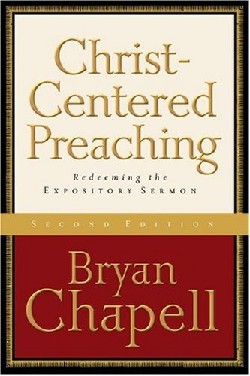
Book Review: Christ-Centered Preaching by Bryan Chappel

9780801027987Bryan Chapell is the former president of Covenant Theological Seminary, the denominational seminary of the Presbyterian Church of America. His book Christ-Centered Preaching: Redeeming the Expository Sermon was first published in 1994, but has seen a renaissance in recent years as Christ-centered biblical theology has become popular in the broader evangelical world. Chapell’s main burden is to provide “principles for redeeming the expository sermon from the well-intended but ill-conceived legalism that characterizes too much evangelical preaching” (20). Thus, Chapell’s overall hope is to move preachers into an understanding and practice of preaching that centers the sermon’s content on the redeeming work of Christ.

OVERVIEW

Christ-Centered Preaching consists of three parts: 1) Principles for Expository Preaching, 2) Preparation of Expository Sermons, and 3) A Theology of Christ-Centered Messages. In part one, Chapell distinguishes between word and witness, saying it is “the Word preached, rather than the preaching of the Word, [that] accomplishes heaven’s purpose” (27). The Word is not simply powerful; it is without peer in its ability to create and transform human beings. This Word is ultimately a witness to Christ. So then, if the word of God transforms people and Christ is central in transformation, then preaching out to ultimately be about Christ. It is in this section where Chapell unpacks his “Fallen Condition Focus” (FCF), his unique contribution to the field, which I will soon evaluate.

With the principles of Christ-centered exposition in place, Chapell moves on to give sound instruction for how to prepare such exposition. The section includes everything from a four-part process of study to the use of outlines to the proper employment of illustrations. The book concludes with two chapters devoted to developing a theology of Christ-centered messages. An aside here is that the book’s value would increase if part’s two and three were revered. In other words, it seems wiser to break up the book as the “What, Why, and How” of Christ-centered preaching instead of “What, How, and Why.” Nevertheless, in part three Chapell shows why he believes that every part of the Bible reveals truth regarding humanity’s fallen condition. Therefore, the purpose of Christ-centered exposition “is to decipher these redemptive signals so that listeners understand a text’s full meaning in the context of its God-glorifying, gospel intent” (273). Redemptive sermons help protect preachers from the moralistic “be like” sermons Chapell sees permeating the church. Redemptive exposition is based on three steps: 1) Identify the Fallen Condition Focus, 2) Specify the Christ Focus, and 3) Discern the Redemptive Purpose (299-305).

THE HINGE ON WHICH IT TURNS

Chapell is particularly effective when he calls preachers to value unity in their sermons by saying, “Each feature of a well-wrought message reflects, refines, and/or develops one major idea” (44). He knows that razor sharp precision to one main idea is no easy task; instead it is one that requires great discipline. “Boiling out extraneous thoughts and crystallizing ideas so that the entire message functions as a unity have tested many a preacher” (44). Yet, the testing is necessary to fight through because unity not only aids preachers, but it aids congregation as well. Chapell is well read in the rhetorical and homiletical history, thus he is right to believe that all good communication – including preaching – requires a dominant theme.

Chapell clearly demonstrates what unity is and is not when puts a preacher through his somewhat famous “3 A.M test.” This test requires the preacher to imagine a spouse, roommate, or church member waking him from a deep slumber in the middle of the night with this simple question, “What’s the sermon about today, Preacher?” Chapell writes, “If you cannot give a crisp answer, the sermon is probably half-baked. Thoughts you cannot gather at 3:00 A.M. are not likely to be caught by others at 11:00 A.M.” (47).

In Colossians 4:4 Paul asks the church to pray for him to preach clearly, “which is how I ought to speak.” Good communication is clear communication. Faithful preaching is clear preaching, and this Chapell understands. Not every sermon needs to be the genesis of revival that will fill history pages for years to come. Yet, in every sermon the preacher must be found faithful (1 Cor. 4:2), thus in every sermon he must be clear. Chapell is right to place such prominence on unity. But from where does such unity come?

Chapell is spot on when he says, “Determining a sermon’s subject is half done when a preacher has discerned what the biblical writer was saying.” It’s is one thing to know what the biblical author said, and another to know why he said what he said. To help the preacher understand the “why” of every text Chapell introduces his “Fallen Condition Focus.” He defines the FCF as “the mutual human condition that contemporary believers share with those to or about whom the text was written that requires the grace of the passage for God’s people to glorify and enjoy him” (50). Drawing from 2 Timothy 3:17 – “All Scripture is breathed out by God . . . so that the man of God might be complete” – Chapell says, “All Scripture has a Fallen Condition Focus” (49-50).  Thus, the FCF “determines the real subject of a message by revealing the Holy Spirit’s purpose(s) in inspiring a passage. Ultimately, a sermon is about how a text says we are to respond biblically to the FCF as it is experienced in our lives – identifying the gracious means that God provides for us to deal with the human brokenness that deprives us of the full experience and expression of his glory” (50-51). The FCF is the hinge on which Chapell’s instruction turns, but is the hinge the right one?

On my first reading I sensed a pause in my soul when Captain Chapell beckoned me on the preaching boat marked “FCF.” It seemed to me that preparing for a sermon would become unnecessarily anthropocentric, always needing to look under the rock of each passage for humanity’s sin. Yet, the more I read and saw the FCF fleshed out my mind became less hesitant. Expecting objections along this line of thinking Chapell says, “An FCF need not be something for which we are guilty or culpable. It simply needs to be an aspect or problem of the human condition that requires the instruction, admonition, and/or comfort of Scripture” (52). Thus, the FCF can be anything from specific sins to grief to longing for Christ’s return to as desire to raise godly children. Identifying the FCF is integral to Christ-centered preaching because it will show the preacher the way in which the passage uniquely points to Christ. So the FCF is necessary because it leads the preacher to examine what the passage reveals about humanity’s need for redemption and what the text reveals about the God who requires redemption (284).

Although the hesitancy did lessen, I am still hesitant enough to not jump on that boat marked “FCF.” It is a novel and largely helpful concept to employ, but it seems likely to flatten preaching into a kind of one-note preaching. I can easily see some preachers employing Chapell’s technique and congregations hearing every sermon ending with the sound of, “You need to be redeemed in this area, and behold, Christ redeems you in this area.” Let it be said that there are far worse one note preaching styles and I don’t think Chapell is aiming for such an end. However, the preacher who constantly has on FCF glasses comes into the passage with a presupposition that can easily cloud the author’s original intent. How can a preacher employ the FCF in Genesis 1 and 2? In Psalm 93 where the entire focus is God’s majesty? If the FCF is a technique of application, then it will be employed to a useful end. Yet, if the FCF is a technique of interpretation, it will fog the preacher’s eyes from seeing the full-orbed majesty of the Scriptures.

The Puritans, as represented by William Perkins, understood the Christ-centricty of all Scripture and still managed to speak about seven different categories of application for every text. Chapell writes, “Keeping the FCF in view from the introduction through the conclusion will help keep application from dangerous steps off the path of exposition” (233). This is where subsuming the main point of the sermon into the FCF of the individual passage fuels monotonous content in preaching. Use the FCF for application, not interpretation.

WHY YOU SHOULD READ IT

The inherent issues in Chapell’s FCF, if I am reading them right, would lead me to recommend that pastors and seminary students read the book, just read it with discernment (as we should read every book!). The impact of Chapell’s book cannot be denied and I do think is deserved. When the appendices are included, the book covers virtually every area under consideration for the task of preaching. He even has wisdom for how to use a microphone, sound wisdom at that! The book will be uniquely helpful for a pastor or student descending from traditions or denominations where moralistic preaching is the norm. Moralistic preaching after all seems to be what Chapell is largely concerned about. Rest assured that his instruction will deflate moralism’s hot air balloon rapidly and effectively. If the only thing preachers take away from the book is to steer clear of moralism, Chapell has succeeded in his aim and served the church well.

Book Details

A Hymn Worth Singing

“How Sweet and Aweful is the Place” is a hymn you should sing. Isaac Watts strikes the spectacular balance of how Christ’s word is the aroma of life and death.

VERSE 1
How sweet and aweful is the place
With Christ within the doors
While everlasting love displays
The choicest of her stores

VERSE 2
While all our hearts and all our songs
Join to admire the feast
Each of us cry with thankful tongues
“Lord, why was I a guest?”

VERSE 3
“Why was I made to hear Thy voice
And enter while there’s room
When thousands make a wretched choice
And rather starve than come?”

VERSE 4
’Twas the same love that spread the feast
That sweetly drew us in
Else we had still refused to taste
And perished in our sin

VERSE 5
Pity the nations, O our God
Constrain the earth to come
Send Thy victorious Word abroad
And bring the strangers home

VERSE 6
We long to see Thy churches full
That all the chosen race
May with one voice and heart and soul
Sing Thy redeeming grace

Walking Down from Preaching

Preaching Header

A few weeks ago I wrote about a personal routine that I rehearse in the moments before walking up to preach. I want to now briefly consider a practice that preachers can perform when walking down from preaching God’s word.

I remember times in years gone by when I would preach, step down from the pulpit, and think to myself, “That was good. I may have even killed it.”

Those were the good ‘ol days.

These days I seem to preach, step down from the pulpit, and immediately think to myself, “Well, there’s always next week. God, help me do better.” I’m sure that anyone who preaches with any regularity can sympathize. Maybe your experience of doubt or despair takes a few hours longer to germinate, but I bet it shows up nonetheless. We need wisdom from the Spirit to discern whether these groanings of the soul are wrought by God to remind us of our weakness and His sufficiency, or if they are fire-tipped arrows from the Devil to crush our confidence in Christ’s word.

When he walked up to preach Spurgeon was said to repeat with each step, “I believe in the Holy Spirit.” Brother preacher, let’s be diligent to repeat the same thing when we walk down those same steps. When you walk down from preaching renew your faith in the Spirit’s power and gird the loins of your soul with this truth:

“The word of God is living and active, sharper than any two-edged sword, piercing to the division of soul and of spirit, of joints and of marrow, and discerning the thoughts and intentions of the heart” (Heb. 4:12).

Insofar as you are faithful to declare the truth of God’s word and the mystery of His gospel, your words have this kind of power.1

  1. The Second Helvetic Confession (1566) famously declares, “The preaching of the Word of God is the Word of God.”

His Throne is the Pulpit

His throne is the pulpit; he stands in Christ’s stead; his message is the Word of God; around him are immortal souls; the Savior, unseen, is beside him; the Holy Spirit broods over the congregation; angels gaze upon the scene, and heaven and hell await the issue. What associations and what vast responsibility! – Matthew Simpson

Quoted in Haddon Robinson, Biblical Preaching: The Development and Delivery of Expository Messages, 12.

The What & How of Preaching

91KBY42uuyLJason Meyer, Piper’s successor at Bethlehem Baptist Church, just published an excellent book entitled Preaching: A Biblical Theology.

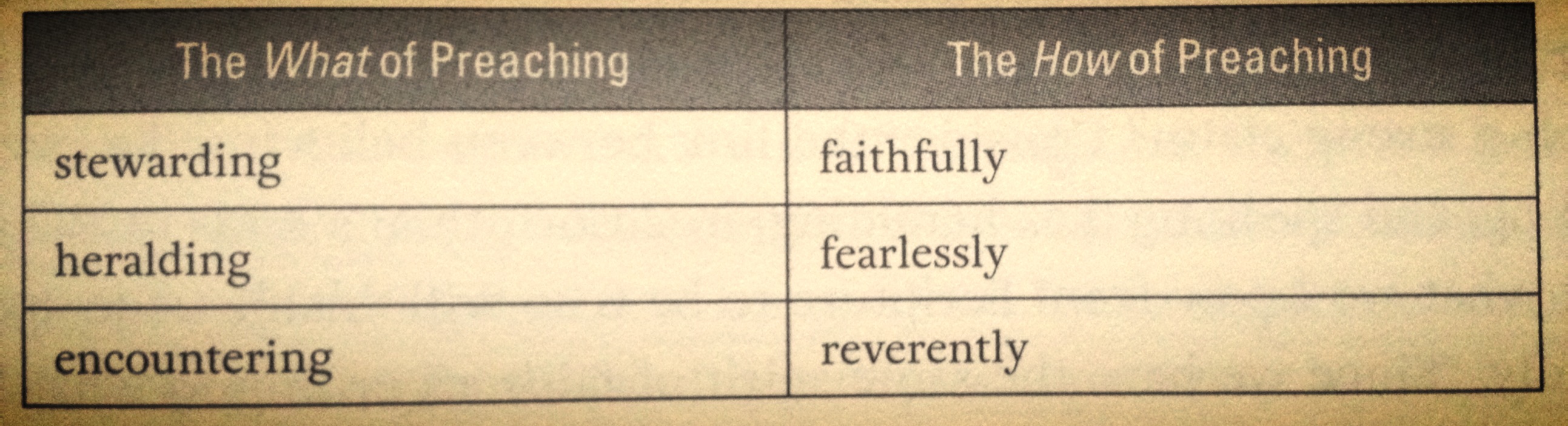
His thesis is that the ministry of the word, according to Scripture, is “stewarding and heralding God’s word in such a way that people encounter God through His word” (21). Three words in this thesis summarize the “what” of preaching: stewarding, heralding, encountering.

THE “WHAT” OF PREACHING

The first phase is the stewarding phase. This phase phase focuses on faithfully receiving God’s word. A steward is not a master, but a servant who is entrusted with something. God is the master and the word is His property, so a preacher receives something not his own.

The second phase is the heralding phase. This is when the preacher gives a human voice to the divine word, so the emphasis in this phase is on the tone of delivery. Preaching is not intended to be a conversational discussion that mimics a fireside chat. Rather, the preacher as a herald, makes his proclamation with a rousing “attention-getting noise” that cannot be ignored. Meyer is also wise to point out that a herald has no authority to tamper with the message he was given. He also has no right to assert his own opinions as if they represent the revealed will of the sender. A faithful herald proclaims the word as an ambassador representing his King.

The third phase is the encountering phase. In this phase the responsibility moves from the preacher to the people. Lord willing, the preacher has just heralded the word with faithfulness, now the congregation must respond to the word with faithfulness. Encountering God through His word is never only a positive encounter. Depending on the hearer, the encounter is either positive or negative. The word will always produce only two responses, a humbling or hardening of the heart. As Paul says in 2 Corinthians 4:3-4, encountering the word is either the smelling of life or death.

photo(1)

THE “HOW” OF PREACHING

Meyer shines brightly when talking about the way in which the word is to be preached. He says, “Stewarding and heralding must be carried out faithfully and fearlessly because the preacher has first encountered God through His word” (31). Meyer thus provides an adverb to each phase to explain “how” a preacher is to preach the word.

Steward the word “faithfully.” “It is required of stewards that they be found faithful,” says Paul in 1 Corinthians 4:1-2. Therefore, the very reality of preaching as stewardship demands faithfulness in preaching.

Herald the word “fearlessly.” The preacher carries the full weight of God’s authority into the pulpit. The sense of authority ought not create pride or self-exaltation, instead the preacher ought to tremble in his soul. Trembling before God means standing confidently before men, thus true fearlessness causes the preacher to speak up instead of holding back or being silent.

Encounter the word “reverently.” Preachers are should be fearless toward man, but reverent toward God. We should fear God alone because He alone has the power to destroy both the body and the soul (Matt. 10:28). “Therefore, all stewarding and heralding should take place in the context of the fear of the Lord” (34).

Meyer sums it all up by speaking of the dual vantage points of preaching,

These three categories are sequential from the vantage point of the hearer: the minister of the word must steward and then herald the word, and then the people should respond with reverent obedience. From the vantage point of the preacher, the order is different. The preacher knows that reverence must mark every stage of the ministry of the word. The minister must start with a reverent fear of God. This reverent fear engenders an aptitude to tremble at his word. (35)

Meyer has done all preachers a great service by so clearly giving three hooks on which to hang the “what” and “how” of preaching: 1) faithfully steward, 2) fearlessly herald, and 3) reverently encounter. Go grab the book, read, and then preach.

The gospel is like a caged lion. It does not need to be defended, it just needs to be let out of its cage. – C.H. Spurgeon

Pastoral Postcard – Above Reproach

Pastoral PostcardEvery few weeks I try to write a “Pastoral Postcard,” a post that aims to encourage pastors in the work of ministry. I take one verse of Scripture and apply it to the blessings and afflictions every gospel minister experiences. The postcards originate from a time when I was preaching through 1 Timothy while reading Thomas Boston’s The Art of Man-Fishing. As a young pastor myself, I tried to channel my inner Boston and write short-ish notes to encourage my labor. Hopefully they can be some encouragement to you.

“If anyone aspires to the office of overseer, he desires a noble task. Therefore an overseer must be above reproach.” – 1 Timothy 3:1-2

Pastor, you are to be a boring picture of godliness.

When the great apostle requires that elders be “above reproach” he is requiring that your life be one free of popular suspicions and charges of sin or immorality. This doesn’t mean you are to be perfect, rather it means that your life will be visibly virtuous.

A VISIBLE LIFE

Faithful shepherds always lead their sheep from the front, thus a faithful pastor will ordinarily be leading from a place of visibility. You know this to be true. From the minute you – and your family – walk through the church doors you are walking into a holy display case. Your actions will be observed and your words will be heard. From the moment you enter this display case the Serpent will try to smash its shell. He will tempt your congregation to be cruel in their judgment of you, so that you will crumble. Or, should your congregation be faithful, he will try to cause you to crumble under your own sinful expectations of perfection that you cry out in despair, “I am not worthy!” If theses schemes don’t work, be assured that the Worm is still slinking around in his sly subtlety.

Have you ever noticed the great number of pastors who delight in keeping to themselves, pastors who cherish seclusion? You are likely one of them. God seems pleased to create His lieutenants in such a way that their introversion leads unto daily swims in the deep things. Remind yourself that the Serpent is pleased by this trait as well. He is familiar with the Spirit’s Sword and the Sovereign One’s desire for shepherds to be examples to the flock. Therefore, you can expect him to aim fiery darts of sinful isolation at your breastplate. To be an example you must be visible, so why should he not try to get you to be invisible? If you keep to yourself, have no friends, stay away from regularly engaging with your town, and don’t regularly lead your sheep in public ways, know the Worm is probably winning the battle. Winning by keeping you invisible.

Cultivate then a heart that mirrors the eternal Three in One, a heart that is outgoing and communicative. Don’t only open the Good Book in your study or on the sacred desk, open it with brothers and sisters as you go from home to home to offer the Whole Counsel. Sin and Satan want you to be sinfully invisible or visibly sinful; God requires that you be visibly virtuous.

A VISIBLY VIRTUOUS LIFE

The apostle’s understands visible virtuousness for he exhorts his son in the faith to, “Set the believers an example in speech, in conduct, in love, in faith, in purity.” This is what it means to be above reproach, to be visibly virtuous.

Be visibly virtuous in speech. You are called to speak of the unsearchable riches of Christ, but don’t let the Good News come from your mouth only when you ascend to the desk. Season all of your speech with the savor of Christ. Resist the temptation of your age to casual colloquialism, but labor in the language of the Loved One. If your speech is accused, let it be accused of having too much faith, hope, and love. Load your heart with the treasures of Christ so that they pour from your lips.

Be visibly virtuous in conduct. You are placed in the holy display case because the Spirit is at work in you to exude a kind of godliness that shapes your sheep. Your actions are to be echoes of the Savior, even if they are often faint echoes. You must daily slay the pride of life to that your life displays and declares the exalted Prize of Eternal Life.

Be visibly virtuous in love. Love is the only thing that will remain in eternity, so let it be the dominant accent of this life. The Serpent will labor to enslave you to love of self or love of the world, but you must terminate his labor with the Spirit’s power. Let your ministry be a two chord song of love, love for your God and love for your people.

Be visibly virtuous in faith. Everything depends on faith, for whatever is not from faith is sin. You were saved by faith and you are being sanctified by faith. The eyes of faith are ones that delight in looking above, looking to where Christ is seated. His is your life and faith alone is what takes hold of that life. Be on guard against doubt and despair, things that come from looking down far too much. Mr. M’Cheyne has it right when he exhorts, “For every look at self, take ten looks at Christ.”

Be visibly virtuous in purity. You know how much the Serpent delights to slay shepherds through impurity, so expect peculiar temptations in this area. Be filled with the Spirit and give no opportunity to the Worm. He wants a foothold here so that he might give a scandal to the scandalized world, but you must close the door of your heart, lock it, and throw away the key. Pray for a mind captivated by, and with, the Beautiful One.

Being above reproach means being beyond spiritual suspicion . . . thus, you shouldn’t surprise your sheep. You should be gloriously boring in godliness. Visibly virtuous pastors are boringly bright pastors who shine and burn for the glory of God.