Recent Reads

I love to read. By God’s grace I am a pretty fast reader; I usually read a couple books each week. I find it helpful to summarize my thoughts on each book and I offer those thoughts in the hope that you will be encouraged to either read or pass over the given title.
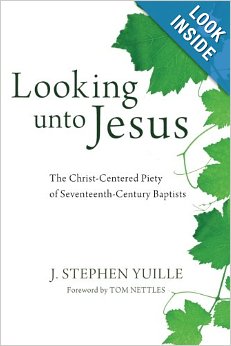
416+GhM92YL._SY344_PJlook-inside-v2,TopRight,1,0_SH20_BO1,204,203,200_Looking Unto Jesus: The Christ-Centered Piety of Seventeenth-Century Baptists by Stephen Yuille. Yuille is an underrated Puritan scholar from Canada who pastors a church down in Glen Rose, Texas. He has published several different works on the Puritans in the last few years and one recent effort is this slim volume Looking Unto Jesus. The book begins with a marvelous introduction where Yuille gives four reasons for why he keeps coming back to the Puritans: they are God-fearing, heaven-seeking, sin-hating, and Christ-exalting. The rest of the work is occupied with two lesser known Puritans, Thomas Wilcox and Vavasor Powell (“The Whitefield of Wales”). Chapter 1 is a reproduction of Wilcox’s A Guide to Eternal Glory and chapter 2 is Yuille’s commentary on the life and work of Wilcox. The patter repeats itself in chapters 3 and 4 with Powell’s Saving Faith Discovered in Three Heavenly Conferences. I found this approach to be novel and useful. For those familiar with the Puritans you could read the original offerings from Wilcox and Powell, and then scan Yuille’s commentary. But for those who find Puritan works daunting, Yuille’s commentary will be a sure guide through the old works. I’d love to see more Puritan titles reprinted in this format. Wilcox’s work is stimulating and Powell’s Conferences offers discriminatory gospel application at its finest.
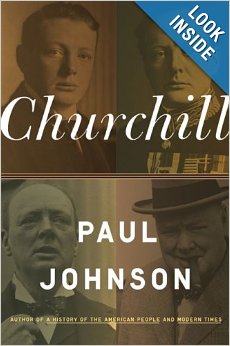
416ffRhqpoL._SY344_PJlook-inside-v2,TopRight,1,0_SH20_BO1,204,203,200_Churchill by Paul Johnson. I read this not long after it came out in 2010 and had been meaning to reread it for some time. Johnson is a great historian and was a young teenager at the end of World War II, thus he is unique suitable to write a brief bio on The Last Lion. Churchill comes in at just over 180 pages, so those looking for in depth analysis of Winston’s life should consult other sources. But I don’t know of a better introduction to that most famous of 20th century leaders. Johnson offers five lessons from Churchill’s life in the epilogue and this section alone is worth the book’s weight in gold. Every leader would do well to consider Johnson’s analysis:

  1. “The first lesson is: always aim high. As a child Churchill received no positive encouragement from his father and little from his mother. He was aware of his failure at school. But he still aimed high.”
  2. “Lesson number two is: there is no substitute for hard work…Mistakes he constantly made, but there was never anything shoddy or idle about his work.”
  3. “Third, and in its way most important, Churchill never allowed mistakes, disaster–personal or national–accidents, illnesses, unpopularity, and criticism to get him down.”
  4. “Fourth, Churchill wasted an extraordinarily small amount of his time and emotional energy on the meannesses of life: recrimination, shifting the blame onto others, malice, revenge seeking, dirty tricks, spreading rumors, harboring grudges, waging vendettas…There is nothing more draining and exhausting than hatred. And malice is bad for the judgment.”
  5. “Finally, the absence of hatred left plenty of room for joy in Churchill’s life…He liked to share his joy, and give joy. It must never forgotten that Churchill was happy with people.”
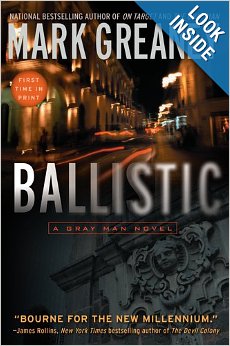
51pi55MjDoL._SY344_PJlook-inside-v2,TopRight,1,0_SH20_BO1,204,203,200_Ballistic by Mark Greaney. The entire world is after Court Gentry, the popular protagonist in Greaney’s Gray Man series, yet the man is impossible to catch. I wondered after reading book two if Greaney hadn’t set “up a trajectory that tempts believability.” Ballistic, book three in the series, proved my fear worthwhile as it repeatedly tries to convince the reader that with Gentry, everything impossible is oh so possible. The action packed book moves is a rapid page turner, but Greaney needs something more than shoot ’em up, bang ’em up virtuosity to make the series compelling. I’ll move on to book four in the hope that Greaney himself can channel the Gray Man and do something unbelievable: offer up more than a one-dimensional thrill ride.


“That Guy”

That Guy

Yesterday I reflected a bit on some soul-searching wisdom from DA Carson. He said, “If I have learned anything in 35 or 40 years of teaching, it is that students don’t learn everything I teach them. What they learn is what I am excited about, the kinds of things I emphasize again and again and again and again. That had better be the gospel.”

One question that always pops into my mind when reading those words is, “What am I known for?” I, like every pastor, probably fit some bill as “that guy,” but what “guy” am I? What guy do I hope to be?

I remember reading an interview with Matt Chandler and he was asked, “To what level do you reveal to your people the suffering and hardship you deal with as a pastor? Is there a point you can exploit suffering?” The first part of his answer was challenging:

One of the things I wanted to be careful about with my ministry was becoming “the cancer guy.” I wanted to be the “gospel guy.”

That answer made me ask, for the first time, “What “guy” am I?

THE “2 TIMOTHY 2:24-25 GUY”

For better or worse, I think about that question a lot. If my wife or my church was asked to identify a few markers of my ministry I have a good hunch how they would answer. And if my hunches were in fact prophetic, I would be ok with the characterization.

But the more and more I preach, pray, and pastor the more I am hopeful that two verses in Scripture would become abundantly true in my ministry: 2 Timothy 2:24-25.

“And the Lord’s servant must not be quarrelsome but kind to everyone, able to teach, patiently enduring evil, correcting his opponents with gentleness.”

Exactly how these two verses could be codified into a “that guy” phrase, I don’t know. But I know this, I want to be that guy.

Of all things that are to be known this is most evident, that God is to be feared, to be reverenced, served, and worshiped; this is so the beginning of knowledge that those know nothing who do not know this. – Matthew Henry

Matthew Henry's Commentary Vol. 3:793.

Your Greatest Excitement

Entrusted with the Gospel

In 1 Timothy 1:8-11 Paul says the the Law of Moses condemns and confronts sinners in their way of life that is contrary to sound doctrine, “in accordance with the gospel of the glory of the blessed God.”

This mention of the gospel now causes Paul to move from a digression on the Law’s condemnation to the Gospel’s salvation. And what a glorious digression it is! The apostolic rabbit trail unveils the cause, nature, and effect of the gospel, which are all summarized in the trustworthy saying of 1 Timothy 1:15: “Christ Jesus came into the world to save sinners.”

The rabbit trail that has the ultimate, and glorious, aim to lead us to faith in Christ.  Yet, I also think Paul’s power packed statement on the gospel and subsequent doxology in 1 Timothy 1:17 should lead us to an important corporate reality:

It would lead us to excitement in the gospel.

What we see in the life and ministry of Paul is that nothing was more exciting to him than God’s glory in Christ as revealed in the gospel.  His remembrance of sin inevitable leads him to cling to the glorious mercy of God in Christ and that good news excites him more than anything else. The importance of this should not be missed and D.A. Carson, one of the greatest biblical scholars of our time, I think captures it best. He said once, “If I have learned anything in 35 or 40 years of teaching, it is that students don’t learn everything I teach them. What they learn is what I am excited about, the kinds of things I emphasize again and again and again and again. That had better be the gospel.”1 What they learn is what I am excited about. So, what excites you?

I pray I would not be known preeminently by secondary things that excite me in this life (and maybe you too): books, diet, exercise, sports, or music.  I pray that our church would be most excited by the love of God in Jesus Christ and such excitement is what we would be known for.

Just a mention of the gospel causes Paul to launch into this most incredible reflection of God’s glory and love in Jesus. A gospel message stuffed into nine words (Christ Jesus came into the world to save sinners), yet if we wanted to we could stretch it into all eternity and never exhaust its unsearchable riches.

What’s Your Vision?

Church Vision

“What’s your vision for the church?” That was a question I received, not for the first time, in a recent membership class at our church. I responded, “It’s really quite simple: preach the word and be faithful to make disciples according to the word.”

But then I said, “If you want a more detailed version of that vision, just look at our church covenant.”

I am increasingly convinced that a church covenant is not only an essential document for the health of a local church, but that it also best represents the church’s collective vision. It’s the document that details how a church commits to live together. By signing the document every church member agrees to help the church to faithfulness and fruitfulness.

Here’s our church covenant.1 Read through it and see if it doesn’t represent a clear and concise vision for the church.

CHURCH COVENANT = CHURCH VISION

Having, as we trust, been brought by divine grace to repent and believe in the Lord Jesus Christ and to give up ourselves to him, and having been baptized upon our profession of faith, in the name of the Father and of the Son and the Holy Spirit, we do now, relying on His gracious aid, solemnly and joyfully renew our covenant with each other.

We will work and pray for the unity of the Spirit in the bond of peace.

We will walk together in brotherly love, as becomes the members of a Christian Church, exercise an affectionate care and watchfulness over each other and faithfully admonish and entreat one another as occasion may require.

We will not forsake the assembling of ourselves together, nor neglect to pray for ourselves and others.

We will endeavor to bring up such as may at any time be under our care, in the nurture and admonition of the Lord, and by a pure and loving example to seek the salvation of our family and friends.

We will rejoice at each others’ happiness and endeavor with tenderness and sympathy to bear each other’s burdens and sorrows.

We will seek, by Divine aid, to live carefully in the world, denying ungodliness and worldly lusts, and remembering that, as we have been voluntarily buried by baptism and raised again from the symbolic grave, so there is on us a special obligation now to lead a new and holy life.

We will work together for the continuance of a faithful evangelical ministry in this church, as we sustain its worship, ordinances, discipline, and doctrines. We will contribute cheerfully and regularly to the support of the ministry, the expenses of the church, the relief of the poor, and the spread of the Gospel through all nations.

We will, when we move from this place, as soon as possible, unite with some other church where we can carry out the spirit of this covenant and the principles of God’s Word.

May the grace of the Lord Jesus Christ, and the love of God, and the fellowship of the Holy Spirit be with us all. Amen.

  1. Originally written in 1878 at Capitol Hill Baptist Church.

8 More Tips for Attention-Grabbing Preaching

Spurgeon Preaching Tips

Yesterday I listed eight exhortations Spurgeon offers for attention-grabbing preaching in his great lecture “Attention!”

Here are the final eight tips, with some choice goodness from the Prince.

8 MORE TIPS FOR ATTENTION-GRABBING PREACHING

  1. In order to maintain attention, avoid being too long.  An old preacher used to say to a young man who preached an hour,–“My dear friend, I do not care what else you preach about, but I wish you would always preach about forty minutes.” We ought seldom to go much beyond that–forty minutes, or, say, three-quarters of an hour. If a fellow cannot say all he has to say in that time, when will he say it? Brevity is a virtue within the reach of all of us; do not let us lose the opportunity of gaining the credit which it brings. If you ask me how you may shorten your sermons, I should say, study them better. Spend more time in the study that you may need less in the pulpit. We are generally longest when we have least to say. A man with a great deal of well-prepared matter will probably not exceed forty minutes; when he has less to say he will go on for fifty minutes, and when he has absolutely nothing he will need an hour to say it in. Attend to these minor things and they will help to retain attention.
  2. If you want to have the attention of your people, it can only be accomplished by their being led by the Spirit of God into an elevated and devout state of mind. If your people are teachable, prayerful, active, earnest, devout, they will come up to the house of God on purpose to get a blessing. They will take their seats prayerfully, asking God to speak to them through you; they will remain on the watch for every word, and will not weary. They will have an appetite for the gospel, for they know the sweetness of the heavenly manna, and they will be eager to gather their appointed portions.
  3. Be interested yourself, and you will interest others. The heart of preaching, the throwing of the soul into it, the earnestness which pleads as for life itself, is half the battle as to gaining attention. At the same time, you cannot hold men’s minds in rapt attention by mere earnestness if you have nothing to say. People will not stand at their doors for ever to hear a fellow beat a drum; they will come out to see what he is at, but when they find that it is much ado about nothing, they will slam the door and go in again, as much as to say, “You have taken us in and we do not like it.” Have something to say, and say it earnestly, and the congregation will be at your feet.
  4. There should be a goodly number of illustrations in our discourses. Illustrate richly and aptly, but not so much with parables imported from foreign sources as with apt similes growing out of the subject itself. Do not, however, think the illustration everything; it is the window, but of what use is the light which it admits if you have nothing for the light to reveal? Garnish your dishes, but remember that the joint is the main point to consider, not the garnishing. Real instruction must be given and solid doctrine taught, or you will find your imagery pall upon your hearers, and they will pine for spiritual meat.
  5. Cultivate “the surprise power.” There is a great deal of force in that for winning attention. Do not say what everybody expected you would say. Keep your sentences out of ruts. If you have already said, “Salvation is all of grace” do not always add, “and not by human merit,” but vary it and say, “Salvation is all of grace; self-righteousness has not a corner to hide its head in.”
  6. A very useful help in securing attention is a pause. Know how to pause. Make a point of interjecting arousing parentheses of quietude. Speech is silver, but silence is golden when hearers are inattentive. Keep on, on, on, on, on, with commonplace matter and monotonous tone, and you are rocking the cradle, and deeper slumbers will result; give the cradle a jerk, and sleep will flee.
  7. Make the people feel that they have an interest in what you are saying to them. This is, in fact, a most essential point, because nobody sleeps while he expects to hear something to his advantage. Self-interest quickens attention. Preach upon practical themes, pressing, present, personal matters, and you will secure an earnest hearing.
  8. Be yourself clothed with the Spirit of God and then no question about attention or non-attention will arise. Come fresh from the closet and from communion with God, to speak to men for God with all your heart and soul, and you must have power over them. You have golden chains in your mouth which will hold them fast. When God speaks men must listen; and though He may speak through a poor feeble man like themselves, the majesty of the truth will compel them to regard His voice. Supernatural power must be your reliance.

“He who has ears let him hear.”

8 Tips for Attention-Grabbing Preaching

Spurgeon Preaching Tips

For the last few months I’ve been rereading Spurgeon’s classic work Lectures to My Students. I know of no book on pastoral ministry filled with such wisdom, truth, humor, and usefulness as this one.

One of my favorite lectures is the one entitled “Attention!” Spurgeon introduces the lectures by saying,

Our subject is one which I find scarcely ever noticed in any books upon homiletics . . . How TO OBTAIN AND RETAIN THE ATTENTION OF OUR HEARERS. Their attention must be gained, or nothing can be done with them: and it must be retained, or we may go on word-spinning, but no good will come of it.

After he puts forth a few preliminary thoughts, he goes on to offer sixteen exhortations or rules on how to grab the congregation’s attention in preaching. Here are the first 8 exhortations (I’ll give the other 8 tomorrow), along with some relevant and requisite pithiness from the Prince.

8 TIPS FOR ATTENTION-GRABBING PREACHING

  1. In order to get attention, the first golden rule is, always say something worth hearing. Give your hearers something which they can treasure up and remember; something likely to be useful to them, the best matter from the best of places, solid doctrine from the divine Word. Give them manna fresh from the skies; not the same thing over and over again, in the same form ad nauseam, like workhouse bread cut into the same shape all the year round. Give them something striking, something that a man might get up in the middle of the night to hear, and which is worth his walking fifty miles to listen to. You are quite capable of doing that. Do it, brethren. Do it continually, and you will have all the attention you can desire.
  2. Let the good matter which you give them be very clearly arranged. Put the truth before men in a logical, orderly manner, so that they can easily remember it, and they will the more readily receive it.
  3. Be sure, moreover, to speak plainly.Our Lord and Master was the King of preachers, and yet He never was above anybody’s comprehension, except so far as the grandeur and glory of His matter were concerned; His words and utterances were such that He spake like “the holy child Jesus.” Let your hearts indite a good matter, clearly arranged and plainly put, and you are pretty sure to gain the ear, and so the heart.
  4. Attend also to your manner of address. Aim in that at the promotion of attention. And here I should say, as a rule do not read your sermons. It is better to do without the manuscript, even if you are driven to recite. It is best of all if you need neither to recite nor to read. If you must read, mind that you do it to perfection. Be the very best of readers, and you had need to be if you would secure attention.
  5. If you be listened to, do not extemporise in the emphatic sense. Do not go into the pulpit and say the first thing that comes to hand, for the uppermost thing with most men is mere froth. Your people need discourses which have been prayed over and laboriously prepared. The best method is, in my judgment, that in which the man does not extemporise the matter, but extemporises the words.
  6. Make your manner as pleasing as it can possibly be. Vary your voice continually. Vary your speed as well–dash as rapidly as a lightning flash, and anon, travel forward in quiet majesty. Shift your accent, move your emphasis, and avoid sing-song. Vary the tone; use the bass sometimes, and let the thunders roll within; at other times speak as you ought to do generally–from the lips, and let your speech be conversational. Anything for a change. Human nature craves for variety, and God grants it in nature, providence and grace; let us have it in sermons also.
  7. As a rule, do no make the introduction too long. It is always a pity to build a great porch to a little house.
  8. In preaching, do not repeat yourselves. Do not repeat the same idea over and over again in other words. Let there be something fresh in each sentence. Be not for ever hammering away at the same nail: yours is a large Bible; permit the people to enjoy its length and breadth.

Recent Reads

I love to read. By God’s grace I am a pretty fast reader; I usually read a couple books each week. I find it helpful to summarize my thoughts on each book and I offer those thoughts in the hope that you will be encouraged to either read or pass over the given title.

418TXytGL2L._SY344_BO1,204,203,200_Christ and the Future: The Bible’s Teaching about the Last Things by Cornelius Venema. Back in 2000 Venema published his masterful study of eschatology entitled Promise of the Futurewhich was a modern reshaping and update of Anthony Hoekema’s landmark The Bible and the Future.1 Banner of Truth felt the size and weight of Promise of the Future would prevent many church members from feasting on its truth. So they commissioned Christ and the Future, an abridgement that cuts down Promise and the Future by over 50%. Venema deals with everything from inaugurated eschatology to the intermediate state to the millenium to final judgment with clarity and color. This book remains my “go to” recommendation for interested lay members. It doesn’t hurt that Venema is a convinced amillennialist.

41Rl95D2EaL._SY344_BO1,204,203,200_Perspectives on Pentecost: New Testament Teaching on the Gifts of the Holy Spirit by Richard Gaffin. Originally published in 1979, this work remains entirely relevant to the contemporary discussion on spiritual gifts. Gaffin’s careful exegesis of the relevant New Testament texts will be daunting for some, but slow reading will be rewarded. The book is short (just over 110 pages) and the tone is irenic, so anyone interested in the debate would do well to wrestle with this one. Chapters 4 and 5, “Prophecy and Tongues” & “The Question of Cessation” will be of unique interest. Regardless of where you stand in the debate on spiritual gifts Gaffin’s work should have a home on your shelf.

51-bcWdscDL._SY344_PJlook-inside-v2,TopRight,1,0_SH20_BO1,204,203,200_Building Her House: Commonsensical Wisdom for Christian Women by Nancy Wilson. This book was one of several I gave my wife for Christmas and it is a treat. I raced through it so I could converse with my wife on its content.  Nancy, the wife of Doug Wilson, writes with a direct style and offers exactly what the subtitle proclaims: commonsensical wisdom. Building Her House is broken up into five parts: 1) Service, 2) Family Relationships, 3) Marriage, 4) Mothering, and 5) Attitudes. The chapters are super short and packed with meditative truth; I could see this being a great discipling tool for women. I plan to add a couple copies to our church’s bookshelf.

515v1vziDSL._SY344_PJlook-inside-v2,TopRight,1,0_SH20_BO1,204,203,200_One Summer: America, 1927 by Bill Bryson. I happened across One Summer on Amazon and it sounded so intriguing that I added it to my Christmas wish list. My in-laws graciously feed my book addiction so this was one of several titles I received at their house on Christmas Eve. And oh my, what a read! Bryson walks the reader through life as it was in America during the summer of 1927, a surprisingly potent season in our nation’s history. Charles Lindbergh crossed the Atlantic, Babe Ruth was on the way to his magical 60, Al Capone ruled corrupt Chicago, the enigmatic Calvin Coolidge dressed up as a cowboy, and a Jack Dempsey fight attracted 150,000 fans. Bryson compellingly weaves the various story lines together, even if many of the characters are treated somewhat irreverently. This was the most fascinating book I’ve read in a long time.

51IFDCklOKL._SY344_PJlook-inside-v2,TopRight,1,0_SH20_BO1,204,203,200_On Target by Mark Greaney. On Target is the second book in Greaney’s Gray Man series, which focuses on the exploits of one Courtland Gentry; a man that everyone wants to catch, but no one can (think Jason Bourne). The series’ first installment was thrillingly paced, but the plot line was thin. On Target has a much more engaging storyline punctuated by surprises. The book’s abrupt ended is redeemed by a solid epilogue, but I do wonder if the conclusion sets up a trajectory that tempts believability. I mean, can Gentry really escape a world, quite literally, every known power in the world? We shall see.

  1. I believe Venema studied under Hoekema.

Edwards on the Word and Prayer

Jonathan Edwards on The Means of Grace

On Wednesday I offered three biblical images or illustrations the venerable Jonathan Edwards employed to illustrate the nature of the means of grace. A necessary question that comes next is, “How did Edwards actually teach and apply the biblical truth on individual means of grace?”

Let’s use those two central means, the Word and prayer, as case studies.1

EDWARDS ON THE WORD AS A MEANS OF GRACE

Edwards said, “The chief means of grace is the Word of God: that standing revelation of the mind and will of God that he gives the world, and it is as it were the sum of all means.” In the Word we are given the mind and will of God for us, so that our minds and wills might be fashioned and shaped after his image. Cooperation with the Spirit conforms our soul to the Word of God, bearing fruit keeping in repentance and have our hearts beat in rhythm with his.

The Word of God, as a means of grace, holds Christ before us, but not in a way that is efficacious. Without the Spirit’s illumination, what we see is just a good man. Edwards says, “The notion that there is a Christ, and that Christ is holy and gracious, is conveyed to the mind by the Word of God: but the sense of the excellency of Christ by reason of that holiness and grace, is nevertheless immediately the work of the Holy Spirit.” This is important for our us because reading the Word is often the easiest way to seem spiritual while living out of the flesh. Reading Scripture can come from a desire to sound theologically intelligent, curry God’s favor, or rid ourselves of guilt from low performance. To truly know God and his Word is to read the Bible with a humble frame, yearning for the Spirit’s work.

Because the Word is God’s primary vehicle to reveal His glory in Jesus Christ, it must thus be the primary means. To understand how to lead our families, pray, fast, and meditate we have to know God’s word. Strobel says, “Hearing and reading the Word of God is the bedrock upon which we faithfully practice the means of grace, because hearing and reading the Word are ground in Christ.” It is in the word that all the other means are understood.

Edwards calls the Word of God the “chief” and “soul” of the means of grace. As we hear and read God’s word we are invited to bask in the glory, beauty, and goodness of God.

EDWARDS ON PRAYER AS A MEANS OF GRACE

If the Word of God orients the other means, prayer gives them life. Diligent use of the means never divorces on of these means from the other, because they are meant to go hand in hand. “Conversation between God and mankind in the world is maintained by God’s word on his part, and prayer on ours,” Edwards writes. “By the former he speaks to us and expresses his mind to us; by the latter we speak to him and express our minds to him.”

As with all means, faith is necessary for prayer to effectively communicate God’s grace to our soul. Edwards reminds us, “That which is necessary in prayer is necessary in faith; for prayer is the only particular exercise and expression of our faith before God.” Historian Michael Haykin has said, “The church as only one posture: prayer.” We are to read God’s word prayerfully, sing prayerfully, hear prayerfully, fellowship prayerfully, and pray even in our prayers (James 5:17).

Like Bible reading, prayer can be practiced in the flesh, but it probably is the least used means of grace to try and better ourselves. Edwards notes that many people leave off praying in secret because they can do so without anyone noticing. As we all know, prayer is difficult and comes with little obvious natural reward. Even though prayer seems clearly focused on God, it is often focused on anything and everything but God. To help us to faithfulness in prayer we must aim to pray from our hearts. Prayer from the heart is the prayer of faith, and anything else is empty talking. Edwards knows this to be true, for he says, “The true spirit of prayer is not other than God’s own Spirit dwelling in the hearts of the saints. And as this spirit comes from God, so doth it naturally tend to God in holy breathings and pantings. It naturally leads to God, to converse with him by prayer.”

Edwards taught that prayer brings us before God and sets our minds and hearts upon him. The prayer of faith is a means of grace because it leads us before God as he really is, creating the space to be with him as we really are. Ultimately, the prayer of faith longs for God and God alone. Without it, Edwards suggests, the Christian life is vain and lacks meaning.

  1. What follows is adapted from Formed for the Glory of God by Kyle Strobel, pp. 85-92.

On Covetousness in Ministry

9780851510873Part III of Charles Bridges’ timeless work The Christian Ministry covers “causes of ministerial inefficiency connected with our personal character.” One such cause is covetousness.

He writes, “Covetousness in ministers has almost grown to a proverb.” “The frequent Scriptural connections of this selfish principle with the sacred office, were doubtless intended to warn the servant of God of a most prevalent temptation.”

I don’t know of a pastor who would disagree that covetousness (which Col. 3:5 calls idolatry) is not always lurking in the shadows. So what is a pastor to do? How can we war against this vaunted, but vanquished, foe? One way is to meditate on Bridges’ answer to the question,

The most effectual preventions of this corroding passion are — to have but few wants — to learn from our poor Christian day-labourers to cultivate faith for the future – to live not for men or for time, but for eternity – to have the glory of God, and the good of our fellow-creatures constantly in view – to study our Master’s life and example – to obtain by habitual eyeing of the cross a gradual conformity to its spirit – and to remember, as Ministers, that an earnest desire to gain continually more souls to God is the sole avarice permitted to a pastor.

Wise. Challenging. Biblical.